Film list of 63 of the best for me

These films are not the best perhaps, or even the best 63 films I have seen, though they would be very close to that.

I simply laid them down without prior thought of ordering or listing them in any kind or categorisation of this or that.

The only change was to add Gosford Park by Robert Altman, and to do that I dropped Mira Nair’s Salaam Bombay! which should not be left out, but I kept Monsoon Wedding which I adored when I first saw it and still do.

So the filmmakers and films are all great and in no way am I listing them in order of best – first to worst. There are no second-best or best here. They are simply all magnificent for all their own reasons and appeared as I remembered them and wrote them down.

Tell me what you think – offer suggestions – i.e. if you wish to.

One Flew Over the Cuckoo’s NestMilos Forman
Butch Cassidy and the Sundance KidGeorge Roy Hill
The Last Picture ShowPeter Bogdanovich
Apocalypse NowFrancis Ford Coppola
Rear WindowAlfred Hitchcock
King of ComedyMartin Scorsese
Raging BullMartin Scorsese
The Good the Bad and the UglySergio Leone
Little Miss SunshineValerie Faris, Jonathan Dayton
Pulp FictionQuentin Tarantino
Reservoir DogsQuentin Tarantino
CasablancaMichael Curtiz
Dog Day AfternoonSydney Lumet
The GodfatherFrancis Ford Coppola
UnforgivenClint Eastwood
2001 A Space OdysseyStanley Kubrick
AmadeusMilos Forman
Blade RunnerRidley Scott
The ThingJohn Carpenter
Ace in the HoleBilly Wilder
The VerdictSydney Lumet
NetworkSydney Lumet
SidewaysAlexander Payne
The French ConnectionWilliam Friedkin
The Godfather IIFrancis Ford Coppola
A Clockwork OrangeStanley Kubrick
Paths of GloryStanley Kubrick
Lawrence of ArabiaDavid Lean
Easy RiderDennis Hopper
ChinatownRoman Polanski
8 1/2Federico Fellini
La Dolce VitaFederico Fellini
The ConversationFrancis Ford Coppola
Out of AfricaSydney Pollack
Annie HallWoody Allen
Hannah and Her SistersWoody Allen
Deconstructing HarryWoody Allen
Broadway Danny RoseWoody Allen
AmarcordFederico Fellini
Day for Night (La Nuit américaine)Francois Truffaut
La règle du jeuJean Renoir
Crimes and MisdemeanoursWoody Allen
The French Connection IIWilliam Friedkin
Thelma and LouiseRidley Scott
GandhiRichard Attenborough
American GraffitiGeorge Lucas
Atlantic CityLouis Malle
Das BootWolfgang Petersen
Monsoon WeddingMira Nair
Gosford ParkRobert Altman
WitnessPeter Weir
PersonaIngmar Bergman
Wild StrawberriesIngmar Bergman
Cries and WhispersIngmar Bergman
Autumn SonataIngmar Bergman
The Truman ShowPeter Weir
Fanny and AlexanderIngmar Bergman
War and PeaceSergei Bondarchuk
YojimboAkira Kurosawa
RashomonAkira Kurosawa
Paris Texas‎Wim Wenders
Schindler’s ListSteven Spielberg
JawsSteven Spielberg

Narratorial Unreliability

Christian Mihai discusses his ideas on unreliable narrators, something he likes to see writers use, and a technique he says he uses himself. Still, he misses a fundamental point – all narrators, storytellers, dramatists, poets, are unreliable. From Homer, Shakespeare to Sartre, no writer tells, gets close to ‘the truth’, even if he or she is prepared to die in the process of collecting all the observable details of a factually based fiction.

Catherine Lacey

Do we trust Tolstoy’s account of Napoleon in War and Peace? Perhaps… if we are Russian.

Narrator unreliability doesn’t have to be a first person account, though the most obvious modernist exploitations of narrator unreliability in fiction use that form. The best approach – for this writer at least – is when the writer sets out to deceive us, and by convincing us that he or she has told the truth, transfers any doubt on narratorial reliability to a reader’s interpretation of the tale.

Experiment, what experiment?

..handheld shaky cam, found footage, ultra-violence, meta-storylines, etc., all becoming part of the broad pop cultural landscape and assimilated into the commercial marketplace. This translates across all cultural lines – music, art, technology, etc. as the outsiders and untouchables of yesteryear are today’s TV spokesmen and tastemakers..

…experimental film seems to represent more fully the true potential and magic of cinema

…for brief moments in history, think the ‘beats’, the real ground-shakers, the true risk-takers, manage to do something that is life and culture affecting, their minds drafting the future…

Sammakon in Turku

I was in Finland last week, in the western city of Turku, facing down five days of clear blue skies and 30 degree sunshine, weather Londoners can only dream about. Turku is a friendly, gentle-paced city.

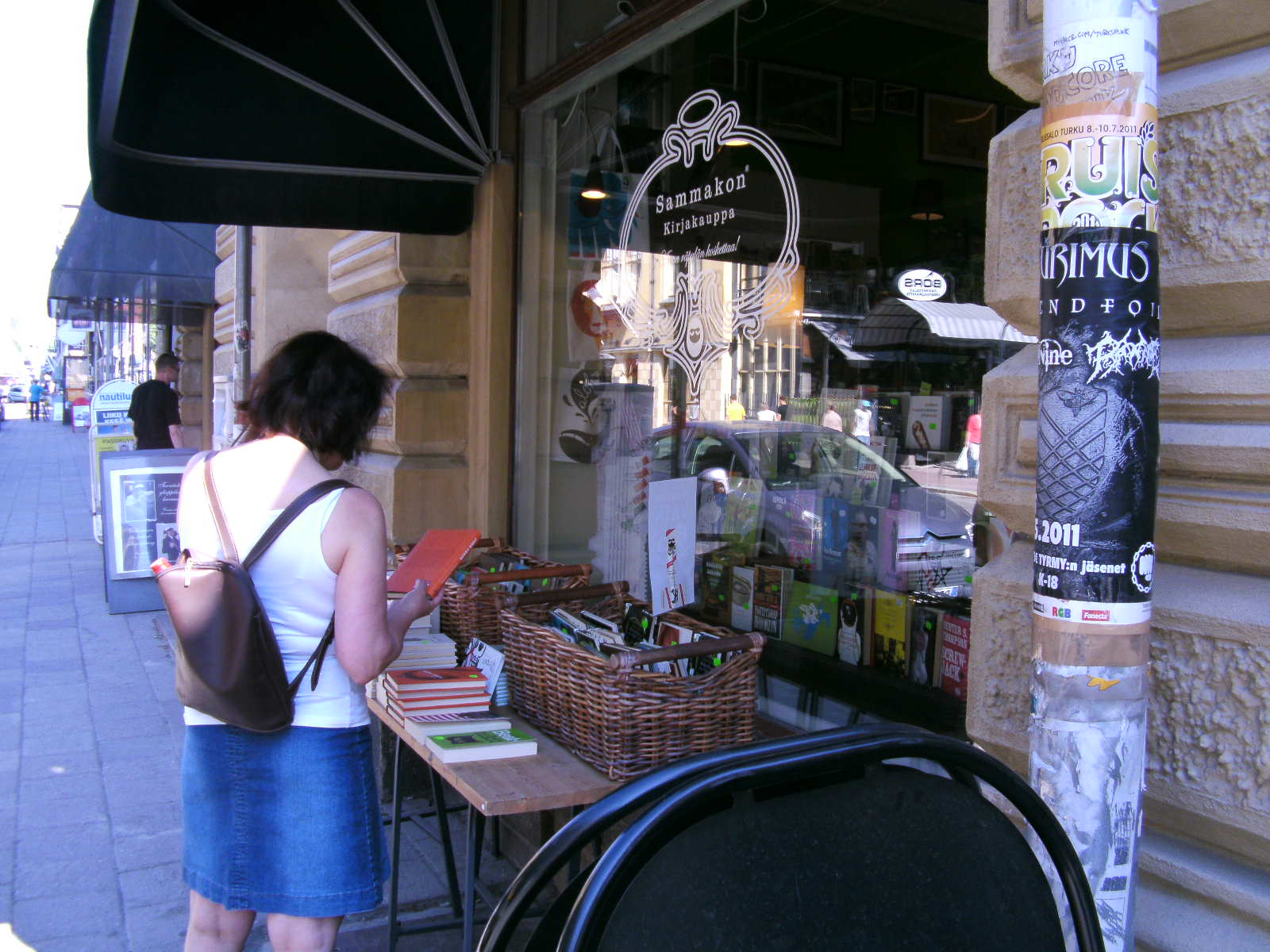
I found a bookshop not far from the hotel.

What caught my eye right away was a small John Fante hardcover in Finnish lying on an outside table, selling for 3 euros.

No dumping books in remainder shops, not in this corner of the bookworld anyway. There it was at a price anyone can afford – with the added value of being in translation. Sammakon is not an average bookshop, even if it could be mistaken for one at first glance.

There are two sammakko.com shops, the other in Helsinki. Sammakon’s owner publishes, sells and translates from English himself, especially his favorites – Bukowski, Fante, the beat poets and novelists. His first book was a translation of Charles Bukowski’s The Days Run Away Like Wild Horses Over the Hills. And don’t they just. After coming across this minor miracle for the world of books in English, one that so intimately caught my eyes, all both of them, it was on the bus for the drive back to Helsinki, for a day and a half of restaurants and walks, before flying back to rainy, chilly London.

Harvey Weinstein, M&Ms (MGMs or MFMs), SCB and the dreaded typo

When I wrote Uncorrected Proof, I thought – as it was a novel set in publish9ng, warts, bad behaviour, mistakes and all – what’s the BIG thing that sticks most in an editor’s craw…the typo of course.

Perhaps there are a few more things that stick in editors’ craws but the typo is a great place for me to start....a craw by the way for those who are not up with the term is ‘a pouch in many birds and some lower animals that resembles a stomach for storage’ ..(worth knowing and possibly connected to the punch-line).

But why should typos stick so deep and hard and mean in the editorial craw? Well, I’m sure it is annoying for editorial purists at times to stumble across a (strategic) typo (that OMG moment, that moment of editorial triumph): SEE how much unhoused-trained writers-like-you need us! Let me be frank, thank the gods for the eagle eye of a munificent editor – like Mike Phelps without the coach-guy telling him how to swim – had to drop a sport reference in there somehow.

But heinous literary crimes aside, and stepping back from the taking of an editor’s role in vain, it seems there might also be a wider issue here, one of power (where Harvey comes in) – when is power never involved? Editors play a very important and often uncredited role  in keeping writers ON MESSAGE – for the benefit of all of society. (Heaven forbid writers are left to their own rational devices on the MESSAGE).

In toto, our creative managers play an important role. Just look at how incredibly naughty & thoughtless Charlie Sheen has been over the last few days. If it hadn’t been for the sensible handling of him by Hollywood’s best and finest (Moonves and the rest), SCB* might just have shocked Libya off the front page. What a travesty, the entertainment industry deflecting our attention back to the real battle – extracting mega-media-revenues from impoverished consumers. Eventually SCB will head back to rehab, end of story (for a while), while Libya’s gonad-breaker keeps us politically glued, at least for a few more daily editions.

Apart from his penchant for power what does Harvey have to do with this?  His critique on CNN of SCB’s obsessions, Harvey’s own craw-charged battles with auto-gratification – on the floor chasing M&Ms – but that, like Charlie Sheen’s reel motives, and my typo-fictionalisations, is another story.

* Sacked Charlie Boy, the saga of off-message Charlie Sheen, a not so ‘poor’ not-so young actor learning how to get over himself.

LA

One Writer’s Swimality Check

In the drink fogly.

When I started my swimalog I thought at the the time I could document the mental processes, thought patterns throughout long(ish) swimming sessions, that’s what I planned anyway.

Q: So you haven’t been successful?

Not if you look at the number of blogs dedicated to swimming, no.

Q: Was it too hard for you?

The long swims were hard enough by themselves but then when I got swim-fit enough I found it wasn’t because it was hard to think and swim, just hard to remember afterwards what my mind was actually thinking while swimming, and the fact a lot of what I did think was banal – like lap 22, lap 23, lap 25, hang on it that was 24 or was it etc. When you cruise you lose track, when it’s hard you are absorbed in muscle fatigue and aches etc and when is this going to end. You might think of a phrase of music that repeats over and over and that goes on in the background of other thoughts or  sometimes even how hungry you are, or just how easy it seems, as you try to concentrate on reaching out your fingertips, keeping your kick to minimum but existent  – we’re talking freestyle here – as you just roll on to lap ends and turns and roll and turn and head on into the next lap and getting through it all. Some days are great, some not so great – banal, as you can see. There are many concerns that run through your mind as well, but the thoughts are fleeting and are lost by the swim’s end. One thing though, the harder it gets, the closer you get you get to the end, the more you are concerned with the physicality of it all – perhaps a precursor of final days concerns in any life.

Q: Okay that’s internally. What about externally – other people? Is it better some days than others?

Better when it rains and the pool empties. Way better.

Q: So you learned, one, that swimming highlights an anti-social side in you, and two, you were forced to give up on the original idea – pretty good progress.

Thanks. I branched out in the blog into other topics to keep myself and potential readers interested. And I’m not anti-social, though I accept swimming has a solitary side to it.  On a bad day I have managed the occasional rant about pool etiquette with someone who looking back may or may not have deserved it – there are two sides always to these sorts of disputes – but I’m well and truly over that. Swim and let swim is my motto now.

Q: So failing yourself and others you learned something of a better way of handling social relations and conventions. But on your main goal, in well over two years of lukewarm attempts, you failed miserably. You set out to observe and not having the stamina to maintain the observatory technique or even capacity to reinvent a charting of the banal progress of an ordinary  swimmer’s daily routine, you gave up. And made no friends.

Thanks. I made one or two friends, a few acquaintances as well. On the observation, you try it, see how far you get.

Q: I didn’t start this idea, you did. So what’s next?

Keep on keeping on. Maybe I will find a way to observe and recount a swimmer’s progress eventually. But in defence of my efforts, it’s a little like writing dialogue – slavish recounting of ‘everyday normal discourse’ rarely makes for good dramatic dialogue, or readable material – ditto for any blog on the mental processes while swimming.

oh dear.
Bukowski


It was Bukowski’s birthday (16th August) – the LA Times alerted me.

“I was drawn to all the wrong things: I liked to drink, I was lazy. I didn’t have a god, politics, ideas, ideals. I was settled into nothingness; a kind of non-being, and I accepted it. It didn’t make for an interesting person, I didn’t want to be interesting, it was too hard.” Women

More than any writer of recent times he made himself and East Hollywood a person and place you wanted to know. In an uncanny way, he made himself the writer you knew without meeting. The story of publication with John Martin and Black Sparrow is a hell of a ride – one that given the state of the publishing industry today makes you shake your head and wonder what went so horribly wrong. How and why did the spivs take control? Moneybags spivs walked in one day and a good part (the best part) of writing and publishing gave up the ghost and died. What happened to that generous reader, writer publisher spirit that John Martin recounts, those early days – he wasn’t imagining or romanticizing it. It was there. (It’s still there in pockets and angles and bolt-holes all over – the connectiveness reliant on the Web – the spivs are desperate to colonise and control the Web now as well.)

Back then when publishing was open for any and all business John Martin said  to Bukowski – I’ll give you a hundred dollars a month (we’re talking late 1960s) and you just write for me. I’ll publish you. Just go and do it. Bukowski went off and wrote Post Office in a whirlwind.

John Martin is still a beacon in a wilderness we really should call –  information control – or entertainment froth – or laugh your way to the little bank blues – not book publishing, not anymore.

Bukowski made you laugh out loud about things that were no laughing matter. He just made his humanness (really, Chinaski’s) matter to you. No one has captured him yet on film. Mickey Rourke and Matt Dillon – put them together, maybe (Jeff Bridges could do Bukowski really well). Or as a friend said – Mickey Rourke now – yes, Rourke or Bridges could do Bukowski now.

Any film takers out there? Any producers with the heart to try again?

ElephantEars Press

Uncorrected Proof Review by Kristin Johannesson

Uncorrected Proof – Louisiana Alba


A review by Kristin Johannesson.“… the random cannibalization of all the styles of the past, the play of random stylistic allusion.” Fredric Jameson.ʻUncorrected Proof’ could be seen as a labyrinthically shaped many-dimensional map, pointing above and beyond itself by showing mirrored images of other places in literary time and space. And that’s one reason why you do not feel trapped by the, also present, postmodern paranoia. In this book as in real life. Painting pictures pointing beyond themselves out into a vast literary universe, you may feel lost in a labyrinth but it can, and for me does, feel like an opening, or a broad road, in it’s freedom to play out and stay away from an apparent order of themes according to fit the forms in the styles of the past, and norms or ideas of originality and individuality. The text stretches out of and becomes wider than the thickening plot, which is something I think can be inferred if employing multiple perspectives on the puzzle pieces presented – which, to use the map metaphor again, can be viewed from a distance at the same time as you are caught up in it/them.

In other words it does, in my opinion and to my appreciation, knit parodies and parallells into something in which it is possible to discern a pattern, in and through the somehow accented spy novel style, making the pictures and scenes full rather than fragmented in relation to the substratum one can sense somewhere in the heart of the text. To try and concentrate my impressions in one sentence I would describe it as confusion in association with the flexibility of not being one and itself. I have personally become deeply involved in this hectic story, and though I have read it over and over from cover to cover I still do not feel I am done with it. I use the word hectic as at many points there is a bit of a stressful atmosphere with the characters and the ones who in parts in their turn play the characters, as with the authors from various times and places who file past. Others such as the fishing scenes and the pasta recipes are a bit of a break, through being a bit more worldly.

Alba’s work in itself is in my view an original one. To pick but a few illustrative
quotes which echo my impressions when reading:

“It is not just a runaway relentless river of words following mental storms or unauthorized brainwaves”,

“Themes do not overflow story into labyrinths of uncertainty, ruthlessly impoverishing if not demolishing, exactitude”.Who in the book in the end is the one or ones who has/have done wrong, if there is such a one in the story, is hard for a non-literary person like myself to express. As for picking the parodies, who has written what may not be the (only) point of interest. Hopefully. I for one am unable to identify most of the over a hundred authors said to figure in the text. To try and espy one final conclusion, a main paradox may be that the novel builds a lot on parody/pastisch as technique and in turn plagiarism as a theme, which could lead to some interesting questions on where the line can/should be drawn, for what kinds of creators, and what you have the right to do what with/with what.Notes from the diary of the reviewer’s work
raw thoughts which c(sh)ould be refined. the truth may be purer in this version than in the next. i’ll go with the next one.

The first copy I read was from the library. I saw some review, got curious, and made a suggestion for the library to buy it (which is my normal way of getting many of the books I read). I read this first, borrowed, copy of the book, among other contexts, while washing clothes and while watching clothes wash.

1: Excerpt Six; Inside the plot (UP, Acknowledgements)
2: Excerpt Four; Archie thinks it through (UP, p 65)
3: Excerpt Five; Alessandro gets on the case (UP, p 71)
4: Excerpt Three; Archie & Cal try to sort it out (UP, p 81)
5: Excerpt One; Ellen Spartan contemplates her fate (UP, p 86)
6: Excerpt Two; Chaos at Folio (UP, p 109)

And later, through X months’ hard labour, resulting in the above, I won my own copy. Fair enough. And fair and square. “[I] found the order (or found the copy on Google Book Search 🙂 Either way, [I] did it.”

“Hi Kristin, the copy will be sent to you on Monday.”

I re-read it when on a flight to New York. And back. I might not have concentrated as hard as I should. At this moment a clarinet played by a neighbour is mixed with birds singing through the open window mixed in turn with relatively silent electroacoustic music from my computer. The temperature is very/too high. And in addition coffeepipyng hoot out of the glede. I also made my own correspondences between style, theme and reading. For example, eating haggis when I read the part on scots. “And yer nae even scottish”. I made the pasta in the recipes in the book when I read those. Following the instructions I did use olive oil. And then I didn’t. (But to use another one of my jotted down quotes from the book “every author lies in every case”, you shouldn’t take my word(s) for this. As for haggis, I’m a vegetarian.) I have also been pondering on the author. One personal (but still quite unoriginal, I have read this opinion in other places) guess on the subject of the author Louisiana Alba, is that this is not a non-fictional character. But I would not swear on that either. “Because I know nothing about this guy.” But I am a “friend” of “his” on Facebook. Some other intriguing passages are for example the equations describing how the book (the book(s) in the book/the actual book) was written, the question “Is that Heidegger quoting Kundera or Kundera quoting Heidegger or Homer Simpson misquoting both?”, and speaking of Homer; blurbs by Homer and Brontë, the pictures of authors on the cover, the thank yous to many more in the preface. The familiarity of them seem to cover and cushion some of the literary tumbles of the eponymous author, the implicit author, the fictional author and the reader.

As at the moment being involved in library and information science, I also at points in my reviewing progress saw parallels to knowledge organization and cataloging, as well as some kind of hyper- or at least intertextuality, in the alphabetical list of authors and artist in the preface, pictures of some of them quite neatly organised on the cover, and and as mentioned reminds me of a map – which a catalogue can be as well, often concerning documents such as literature and often interesting in itself in what has been chosen for representing and how it is represented, making new stories out of, as well as new relations and associations, between older works. Some of the charm of this book lies in it waking curiosity and associations, and some of the challenge with the book lies in it making you want to solve some of its riddles, such as where allusions are, to whom, and what this in turn might imply if interpreted “correctly.”

The Paste Land
“Lou maintains you have look through the prism of Duchamp’s Mona Lisa..the mustache on the most famous woman in art..Everything is a comment, a value add on, a parodic piece of fun, a slide off the original text into something else..built inside text which itself is built inside text and so on..Foucault’s comment in ‘What is an author’, an author is only a collection of statements that have come before, comes into play. Writers often play with borrowed stories (Shakespeare mercilessly so)..Lou referenced over 100 styles. T.S. Eliot borrowed from the whole of the literary world. The Waste Land could be The Paste Land. (You are quite free to use our emails as well if you like – Uncorrected Proof is an open book published by an open press)”

– Geoff Berry… ElephantEars Press – e-mail correspondence June 2010
http://elephantearspress.com

Plot…is that all there is to fiction?

Laura Miller of Salon is one of a long line of ‘I know best-ers’ to throw the tired old crumbly stones of  ‘writing commandments’ from the journalistic mountaintop http://www.salon.com/books/laura_miller/2010/02/23/readers_advice_to_writers/index.html(was-there-not-anymore) :

  1. Make your main character want something.
  2. Make your main character do something.
  3. The components of a novel that readers care about most are, in order: story, characters, theme, atmosphere/setting.
  4. Remember that nobody agrees on what a beautiful prose style is and most readers either can’t recognize “good writing” or don’t value it that much.
  5. A sense of humor couldn’t hurt.

Anyone who champions rules of commercial fiction risks sinking creativity to the lowest common denominator in the reader’s mind. It is so easy to force feed unknowing audiences junk culture, just as easy as it has been to promote junk food. And where has junk food got us? If Laura or anyone attacks quality or ‘difference’ be it in art, commercial fiction, food or politics, in the end, logically, it leads to totalitarianism. Commercial control of a cultural market, or political control of a society have similar roots.

We are not animals tethered to a plot line only – sophisticated readers want more than plot. If anyone reads War and Peace (a great read by the way, easy to read, entertaining and enjoyable) it is a long time before any one character assumes ‘the what’s going to happen to me next driver’ aspect to his or her role, but it is there – but it is always there as part of ‘the life’ in the novel – what will happen today? It is part of all of us – but there is much more to enjoy in Tolstoy’s novel, as there is in reading Year of the Death of Ricardo Reis, The Outsider, As I lay Dying, and A Hundred Years of Solitude – all examples of novels and narratives that are far more mysterious and compelling than commercial fiction that obeys these silly rules Laura speaks of. In The Great Gatsby, what do we ever discover really of Gatsby? – not a great deal, more than half Fitzgerald’s point. Nick, we get to know, the character we engage with, the thinking centre of the novel. Hamlet was introspective and procrastinating and one of the greatest characters of all time. Just because lowest-common-denominator is now the major dollar driving factor in contemporary reading culture doesn’t make it good or good to read. The only comment I agree with is the last – laugh while you write and hope like hell the reader laughs with you!

“Naturally, writers of genius have broken these “rules” as well as every other rule ever conceived. But, let’s face it, geniuses don’t need lists like this and couldn’t follow them even if they tried. Most writers are not geniuses, and most readers would be exhausted by a literary diet that consisted only of the works of geniuses.”

This is Laura’s ‘a genius can do it, but the rest can’t argument’ which in effect shuts down experiment, closes the door on dissent. Who knows what genius is? It was 200 years before the Romantics woke up and declared Shakespeare a genius. All we can really hope for is that creativity in any novel is whatever form it takes when exciting readers. If a writer takes readers somewhere we haven’t been, surprises us in some way then it is an achievement worth applause. The ‘Only a genius can break the rules’ argument is another argument for more gatekeeping. This ‘we know the rules’ is nonsense. And even if someone like Laura could for a moment make a good fist of why she subscribes to her only a genius-can-break-rules-theory, very few of the ‘genius writers’ she’ll choose will surprise even her all of the time. No book or writer is untouchable. Everybody can be criticized, even Shakespeare. Logically, if anyone follows these, or any rules, they will become slaves of a market mechanism. Rules for fiction or any other art form only end up filling the pockets of the chosen and promoted writers. Rules lead straight to homogenization (though that doesn’t mean you can’t have a little fun with rules, while you’re doing other more interesting things) …go-go genius go.