Novelistsdon’t write alone. The unconscious does the heavy lifting. While conscious, many writers can be like stenographers with a flair for editing.
What we say about ourselves consciously in the life writing or self histories has always to be viewed sceptically. An insight that seemed to me profound hearing it many, many years ago: it’s not what we put in diaries that counts. It’s what we leave out.
Does the unsaid in life writing count for more than the said? Some people are remarkably honest about themselves, but would I consciously leave out things in any life writing? Yes.
Autobiography is too self-aggrandizing. Fiction is more fun to do. Fiction frees up writers to find and tell truths he/she wouldn’t admit to when writing about themselves.
Grifters, sharks, wannabes, liars, creativors cruise the seaside Promenade as an enfranchising of an entire festival grows out of protest, taking voting from annual juries and giving it to the fans, without whom the festival would not be.
When I was writing this the second invasion of Ukraine hadn’t happened. When I was in the the final draft oligarchs lived only in Russia. Now they’re hard at gaming America. When I was in the final draft, political sycophancy was in its infancy now it’s fully grown.
When I was in the final draft there was still an operational Democratic Party, now a couple State governors are performing CPR on its seemingly lifeless body. When I began writing this most of America believed in habeas corpus, personal and civil rights, accountability and independence of the judiciary.
When I was writing this novel it wasn’t clear how much damage the right wing of the Supreme Court could inflict on America.
In the summer of 1981, my first trip to Greece, one late hot July evening, I wandered up the road from my Plaka hotel to the Acropolis, a young filmmaker on holiday, a working resident from Hong Kong visiting Europe.
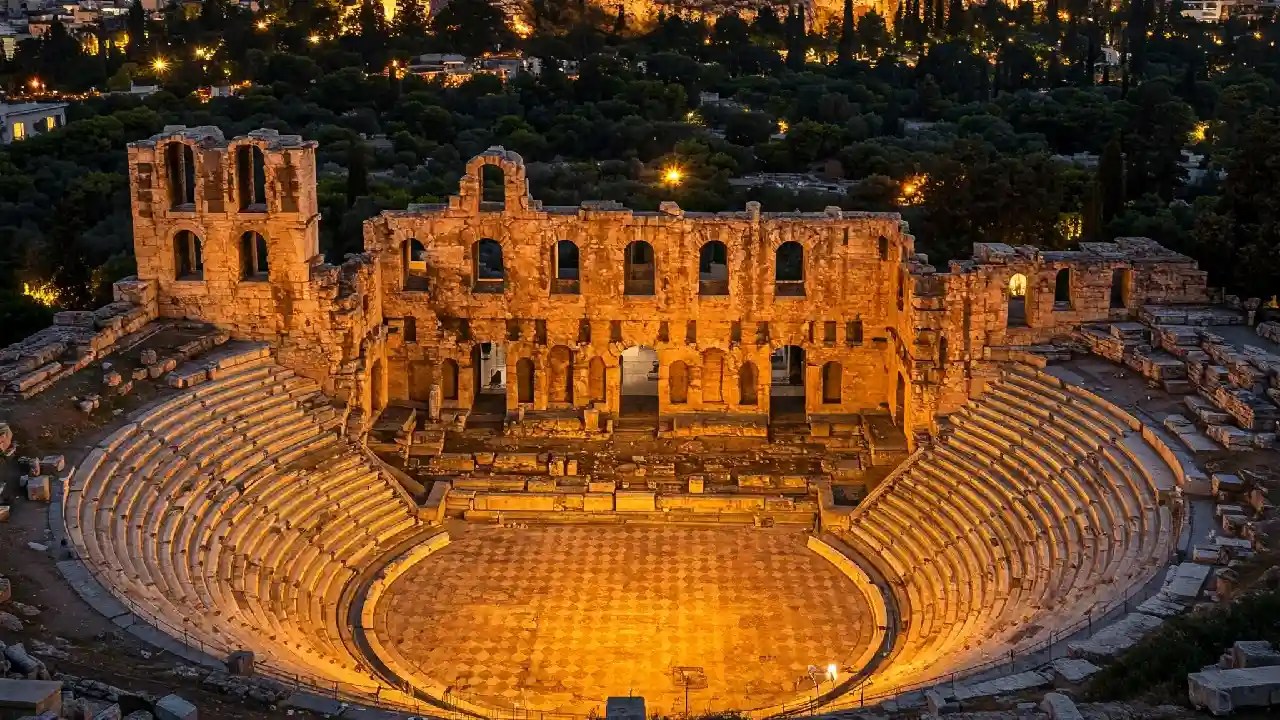
As darkness gathered I sat on a perimeter wall and took in the summer dusk scenery all around. Facing the seaward south I stared down from my spot at the lit up Odeon of Herodes Atticus theatre way down below me. A rehearsal was going on. After watching for a short while I walked back to the entrance road, took another path the other way, hiking down the hill to find out what it was I had just seen.
A poster outside the Odeon announced that the Athens Summer Festival was showing Aristophanes’ The Acharnians. Had I seen a play by Aristophanes before? No.
I returned to my hotel, and the next day found a ticket seller in Athens. I bought a seat for the play – prices of the day ranging from $1.20 to $6. I bought a Penguin translation of the play in a bookshop and read it, and certainly no wiser, set off the following night to see the performance.
The Acharnians was first performed in 426 BC. A strident anti-war play it is credited as the oldest staging of a western threatrical (Greek) comedy. I didn’t know what to expect because the Penguin version, translated into English, did not make it clear. Still, I had seen the rehearsal. I had seen something intriguing. The play would do the rest.
The Odeon theatre is an extraordinary space but on a hot July summer’s night it is other-worldly, the night air made translucent by light alive with what looked like tiny floating tippy tips of flowers, rising in the lit-up warm evening air all throughout the amphitheatre.
In jeans, t-shirt and sandals, surrounded by Greeks in evening dress I was an outsider but nobody cared about me. They were there to see a play, an important play in the ancient Greek canon.
What truly resonates with me most now forty plus years later, is how an ancient play, interpreted, performed and directed as it was, was so relevant to me and that 1981 audience. I spoke no Greek yet the production literally lifted me off my seat. This was not a stilted ancient classic, the sort of production I remembered too well from university productions. The Penguin translation was swept from my mind.
Dicæopolis, a native of Acharnæ, and an ex-soldier, returns utterly disillusioned and deeply angered by the Persian wars, heartsick at the misery and stupidity of conflict. Not shy in making his anti-war views known he railed against his fellow citizens chastising them with lewd gestures while a chorus of indignant citizens in white masks, odd hats and fantastic sewn quilt-like costumes, rushed from one side of the stage to the other, all this happening in a cacophony of startling music and sound effects, the chorus remonstrating and arguing with Dicæopolis and each other. The audience was in stitches. I didn’t understand a word, yet understood everything.
As a writer it’s hard to communicate the effect this experience has had on me from that hot July Athenian summer’s night onward. The Archarnians is the western world’s most ancient staged comedy, its performance having Greeks no doubt in ancient times, almost rolling in aisles as Greeks were doing around me.
When the performance ended, the revered director Karolos Koun was brought on stage to receive a rousing applause. I sat stunned by what I had seen. It had transcended any theatrical piece I had been to see by multiples I can’t calculate even today. I felt the meaning of theatre not only the ancient Greek idea of ‘spectacle’ had been made clear to me, with meaning in my writing perhaps beginning that night as well.
The films featuring Gene Hackman are unique. From his life filled with experiences he had to overcome through to one of his best performances in Unforgiven, he quietly made acting history. His work on David Webb Peoples screenplay under Clint Eastwood’s direction, whose technique encouraged contributors to be how they saw fit to be, created a Hollywood “white page” screenplay legend, a rare production – a film screening as the writer intended it to be when he first wrote it.
Unforgiven was perfect for Gene nearing the end of his career, and it won him his second Oscar. If Joyce wrote a novel about him its title would be, “A Portrait of the Actor as a Working Professional”.
I am a writer, novelist, living and writing on the south coast of France, where I swim and continue renovating my apartment.
I am very close to finishing a novel set in 1963. My recently published novel Out of Competition, published by JEF Books, Illinois, October 1, 2024 won the Kenneth Patchen Award for the Innovative Novel.
I grew up watching Superman, The Cisco Kid, O.S.S., hearing war stories, chasing down moth-eaten army uniforms back when milk arrived in a horse and cart marvelling at the colour style of actual coca leaf sugarpop in Coke bottles blinking at motor cycles Dick Van Dyke falling over a couch cowboy films shot in daylight B/W then coloured nights of my father’s home-grown vegetables, born with words in my mouth – ‘gimme-that’ , ‘how-dare-you’, ‘what-the-fuck’ –
– ideas as fixed and eternal as the motives for every war, growing into Kidnapped bicycles desert boots Seventy Seven Sunset Strip Disney Land Rear Window Psycho Lawrence of Arabia, the annual anxiety of packing the car at holiday time, each and every moment stilled in memory of the forever mysterious parodies of life or art even if parodies weren’t even an option back then. I knew the Beatles before the Monkees, Bogart before Belmondo, but I can’t say I recall the idea behind the Summer of ’42 before it was a film conjured into a Mad magazine parody or whether it co-existed in the smash crash and kill dinky toy mind of George W. Bush. I believe I’m not alone, even growing more bewildered year on year by the incoherence of images and texts surrounding me from birth arresting my natural river environment in the far southern climes the commercial and cultural ink-blotting over my childhood my natural world a parody of some story my mother told me, those seconds on a baked sidewalk hearing JFK was dead, pink socks on the rock ‘n rollers, moments things events sounds sent to make life even more dangerous curious frightening, a direct result of the industrial military complex, Elvis Presley Chuck Berry even, the jack shit political influences beaten into the worrying shame of death in the world, prejudice, organically connected and woven into a general valueness held dear by so many years on from that day when morality was gunned down in broad daylight.
It is, I assure you, an infuriating mess, a refuge, a joy to behold, an acrimonious cesspool of computerisable angst, an endless checklist of outso(u)rcerized disputes – a hole in the wall for all the world’s minds to filter down onto damaged DVDs. They will in time. And this you will find will be their final resting place.
The staff are miraculous, critically underpaid, limitlessly incompetent, irritatingly profound, delightfully empty, lazified beyond imagining, utterly perfect in their rhombus like cartoon feature creatures silicon graphic simulatoring carnival spirit. They sit there one at a time in that hell’s kitchen like Camusian sentences in utter knowing decrepitude.
If I could ever find the title I crave, the one I have up here, I will throw a week long party for all of you (send me yr contact). As a photocopier – though – to be honest – let’s be fair – my local is the soul of efficiency. As a printer of documents it is besmirchless –
….any fault the computer hard-drives at you is not down to the poor beleaguered impoverished centre.
It is a meeting, as it were or was – point by point – planned, for the perfect silence of minds, brought to life ONLY by murmuring mobile phonies and at least one hundred SE-a-MLESS dialects.
Not a letter I know is transferrable in order to patronise misapplication by default (if you know how to approach it). So…All hail to my local
Louisiana Alba is the author ofUncorrected Proof, which I heart, so I asked if she would write something just for me (and you lit-lovers). Here ’tis:
Italians have a phrase: nonmettere le mani avanti, don’t put your hands out in front (to prevent the fall you fear). Let the scholars sort out my fictions. I am trading here on memory and instinct alone, a dangerous line, I know, particularly as I was going to do a piece on Windschuttle and other historical fabrications. Do you know Windschuttle? Does anyone care? No? Then, I best leave him for another time.
Nam Le has just won the Dylan Thomas Prize. This is no small prize and no small feat, I said to myself, then realised I was staring at my own. My feet were the only feet in the room. I was intrigued though I confess I didn’t know Nam Le’s work before I went online and ordered the one copy of The Boat held by the British Library. The book of The Boat. The Boat in book form. It says a lot about the focus of readers in London that it hadn’t been snapped up already. After the Booker Prize shortlist was announced every copy of every book the BL had by every writer on the damn list was in use. Hell, what’s going on? I said at the time.
Nam Le, who is he? When no answers came I could interpret I webbed wider to find out more. I came upon: ‘Love and Honour and Pity and Pride and Compassion and Sacrifice’, from The Boat itself. I read the screen-printed story. Even in the twenty-first century I still find it hard to read fiction this way. Yet Nam Le had me hooked with his first words. The Boat had cast me a line. ‘LHPPCS’ is a fine and good story, as Hemingway might have said. I saw echoes, or imagined I did. Thom Jones’s an-American-in-Vietnam stories, what was Nam Le doing here, a parody of memoir technique developed by a writer come writing-teacher in an Iowa writing school? Many stylistic lines from many American short story writers crossed my eye-line, Le skilfully self-addressing the author, wannabe, manqué throughout.
Thom Jones is still on that Iowa program I believe. I have long admired his work and reference him in Uncorrected Proof. Judging by ‘LHPPCS’, I feel no less strongly about Nam Le’s capacities, finding the comments of praise I saw this morning true and right down to the last syllable. Hemingway is an apt voice to mention as well, I suspect, for what happens at the end of ‘LHPPCS’ happens to the Hemingwayequestrian character in The Garden of Eden as well – the writing and story of both characters ending up…No, I can’t say it either.
Let me be frank or… Nam Le. This writing strikes more than one chord, literary and life chords. When I first left Australia, after university and film school, my first assignment abroad was to film a boat full of ex-Vietnamese hitting land in southern Thailand. Pure fate. It was only the second time I had professionally put an Eclair 16mm camera up on my shoulder, only the second time I had used one live full-stop. As I clambered about the decks of beached boats, sweat running in my eyes, the stench of summer in the Gulf of Thailand all around, somehow I kept the excitement of the waving forms motoring towards me in focus, somehow I maintained the other arrivees close-by in frame, somehow I didn’t end up in that murky Thai seaside drink all sides up. All along I had no idea I would revisit this plot and theme several times in my life.
I move on to Hong Kong filming and producing two more films on escapees from a hell on wheels inside Vietnam, to a fate far worse than the Thai camps, if my olfactory memory of the warehouses along Hong Kong’s Pearl Harbour serves me well. My fourth and last experience is back in Sydney six years later, making a film for Special Broadcasting Service on a need some Vietnamese children developed for writing up their experiences. In a Strange Land, one girl titled her poem, or was it tilted, living out a nightmarish late childhood horror that was Cabramatta, or as some Australians casually called it back then, Vietnamatta. Reading Nam Le brings it all back.
What is Nam Le’s ‘LHPPCS’ all about then? Writing in Iowa? Growing up in Australia? Relationships? Remembering Mum? Revisiting or leaving Vietnam behind? Getting onto livable terms with Dad? Memory in ‘Love and Honour and Pity and Pride and Compassion and Sacrifice’ is a wonderfully cruel trick. We live and die by it along with his character in the same instant. Nam Le’s memoir, the memory of his life’s truths as laid out in fiction, is an examination of a fictionalised ‘ex-Boat person’ narrated in such an unadorned air of truth that if the other stories in the collection are even half as good, then I know in truth I am in for even more of this rare treat.
Can’t wait to see what she says after reading the rest! – LM
These holidays ElephantEars Press wants to give readers a real and true deal.
Lately, I have been following Amazon’s attempt to monopolize Print On Demand, to force independent publishers to accept Amazon on terms designed to crush the life out of the independent publishers and booksellers. It’s a disgrace – Amazon only got where it is because readers like you and me helped them become a force. We supported them in the early days because we wanted diversity, because we believed they were for us. Not anymore they aint!
Amazon wants to monopolize bookselling and print on demand publishing. They want to to kill off publishing independents and consumer independence. Don’t let them. Buy from small independent presses like ElephantEars. Support small and ignore the big homogenizers of creative output.