Where to now?

The advocate for voting rights, Marc Elias, posted this on Democracy Docket.

Marc writes:

Four years ago, on Jan. 27, 2022, Black Alabama voters notched a significant victory when a federal court ordered a new congressional map to be put in place with two, rather than one, minority opportunity districts.

Ten days later, at the request of the Republican state officials, the Supreme Court blocked that victory. “Late judicial tinkering with election laws can lead to disruption and to unanticipated and unfair consequences for candidates, political parties, and voters, among others,” Justices Kavanaugh and Alito wrote. The primary was nearly four months away.

On Nov. 21, 2025, Black and Latino voters successfully blocked Texas’ new gerrymandered map in federal court.

Two weeks later, the Supreme Court stayed that order, holding that in granting minority voters relief, “the District Court improperly inserted itself into an active primary campaign, causing much confusion and upsetting the delicate federal-state balance in elections.” The Texas congressional primary was not until March 3, 2026.

Last night, at approximately 7:20 p.m., the Supreme Court expedited its normal process to allow Louisiana to take advantage of last week’s decision gutting the Voting Rights Act. The election in Louisiana is already underway — voting has started, and ballots have been cast.

Justices Alito, Gorsuch and Thomas explained that they were required to act because otherwise the “2026 congressional elections in Louisiana [will] be held under a map that has been held to be unconstitutional.”

The same Court that blocked relief for Black Alabamians because the primary was four months away, and stayed a Texas order because it might disrupt an ongoing primary campaign, had no such concerns when the beneficiaries were Republican politicians rather than minority voters.

The fallout was instantaneous. Louisiana Republicans can now redistrict to replace at least one Black Democratic member of Congress with a Republican. And they can do it on very short notice.

It was not enough for the Supreme Court to gut the Voting Rights Act. When push came to shove, the conservative majority rushed to do it in time to impact the 2026 election.

The damage the Court has done is incalculable.

I am under no illusions that the Supreme Court applies the law without regard to political outcome. I understand that the deck is stacked against us. But I am embarrassed to say that I was surprised by this outcome.

I expected the Supreme Court to gut the Voting Rights Act. I was prepared for it to do so under the cynical guise of redefining what it means to discriminate against minority voters.

But I confess that I did not think the Supreme Court — even this Supreme Court — would short-circuit its normal process to allow Louisiana to suspend ongoing elections after ballots had been cast in furtherance of enabling Republican gerrymandering.

We expect politicians to act in their partisan interest. But we expect Courts to at least hide their own preferences.

Courts typically wax poetic about voters and the foundational importance of their rights. But in this instance, the citizens of Louisiana are an afterthought. Black voters are simply an obstacle to be diminished and overcome. The masks are off.

For the last 60 years, as conservative politicians have thrown up barriers and silenced their own citizens, courts have been the last line of defense for voting rights. That backstop is now gone. What we are witnessing is not just a legal setback. Rather, the Court is undergoing a fundamental realignment of who it is willing to protect.

I have won and lost important cases. I know that Courts can be unpredictable and disappointing. I know that justices are not merely neutral arbiters, and justice is not always served.

But the events of the last week are painful in a different way. It is not that the Court ruled against what I believe the law and Constitution require, but for the first time, it seems the justices have given up even trying to hide what they are doing. Maybe because society no longer requires the facade.

If I am honest, there is a part of me that wants to just give up. I found myself awake last night asking, what is the point of litigating voting and election cases if the scales of justice are this tilted against you and your clients?

But that is not an option for me, for my clients or those who care about democracy.

– Marc Elias
“Was Life Simpler Back Then?” Vol. 4. Brittle realities-2.

So from September 1979 I made films for our new once a week magazine TV, hour long program, Here and Now. The same routine for me, a film every week, which morphed into longer films later. Some pieces I did were good stuff even if I say so myself. Yet, the founder of the program, deputy director Stuart W., lamented the lack of journalistic impact. The program without the set-up of Panorama or Newsnight wasn’t news.

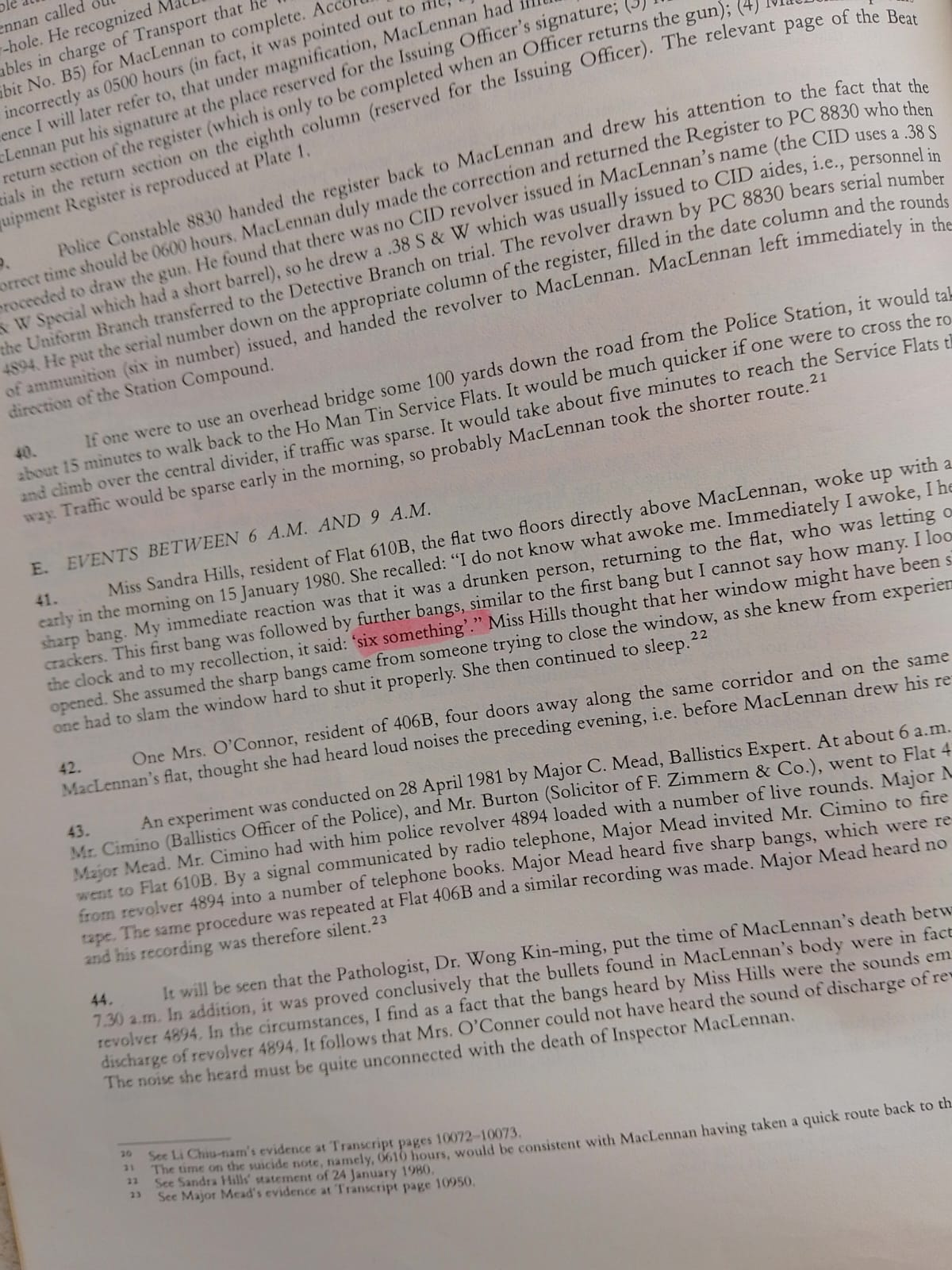
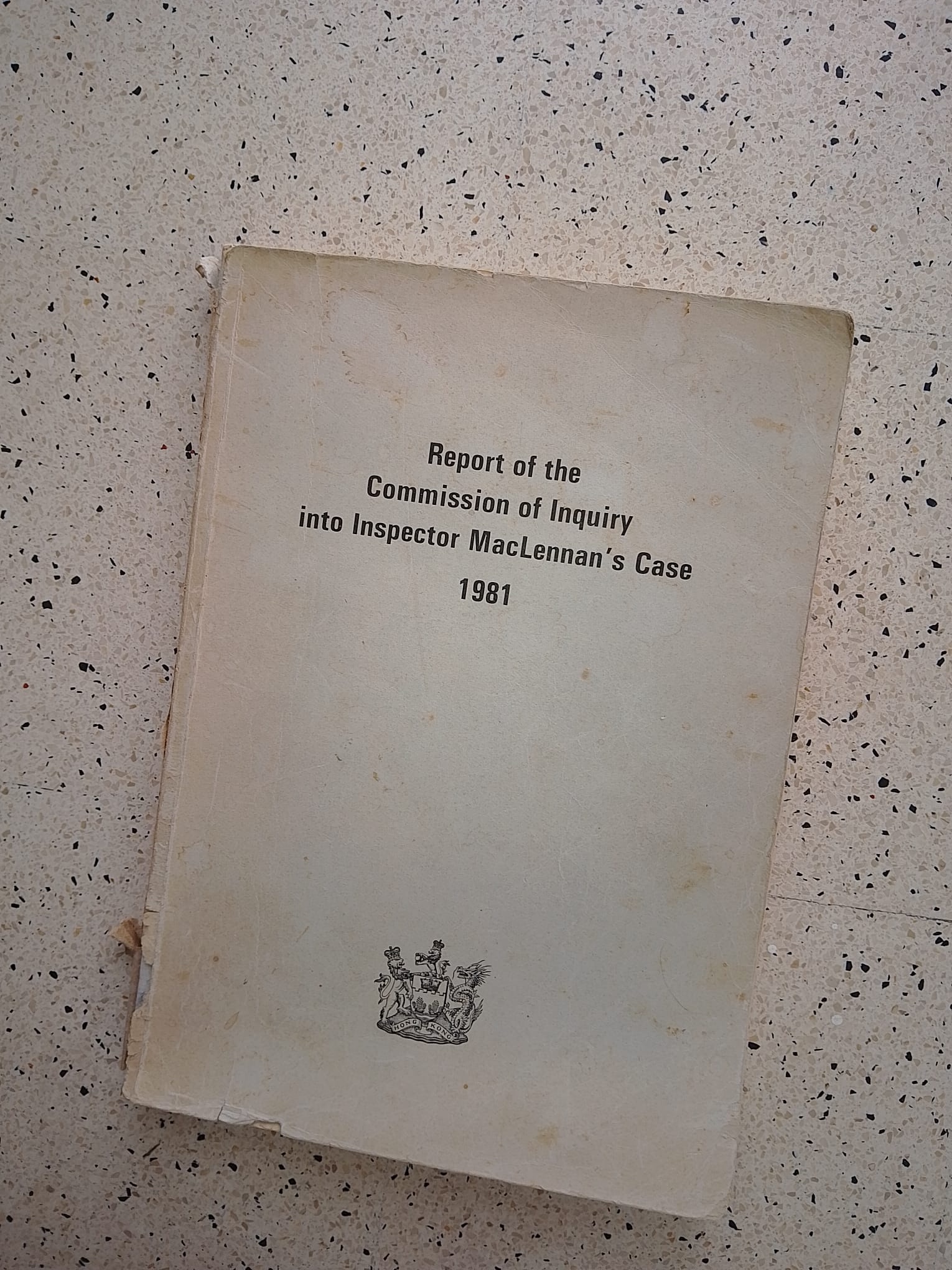
After two years a story arrived that gave us our chance—a 1981 official report of by Justice Yang of his special Inquiry into the death of a police inspector, John MacLennan.

John Maclennan had been found with five bullet wounds in his torso, and the immediate police judgment was suicide. The kill shot went through his heart and liver, which for right-handed John meant he had to angle the gun down and across his body, a contortion that would enable him to hit his heart at the top left, the bullet travelling across to the lower right, piercing his liver. As a suicide it didn’t make sense at all.

John Maclennan had been investigating ‘the gay question’ in Hong Kong and the story of Chinese rent boys. At that point in time it was a still a capital crime on the Hong Kong statutes, meaning a man could be sentenced to death for being homosexual. At that time, the Police Commissioner, Roy Henry, lived alone except for his Malay servant boy. At that time many of the Hong Kong establishment were known gays.

I was the producer of the hour. I worked with two journalists on the report, one a young Englishman (twenties like me) and a Canadian Chinese girl.

We did a good job, beginning the hour with an early morning image of MacLennan’s block where he had an apartment, in which he was found dead. Over the still early morning image of his building came the startling sound of five gunshots in more or less the manner audio witnesses said they heard them.

We had good interviewees with one of the best quotes on Justice Yang’s very detailed report, from a gay Englishman: ‘I just want to put the whole inquiry behind me.’

To put it bluntly, the whole issue by late twentieth century standards was a joke and the conservative justice, Yang, didn’t spare any establishment members with his critique. Nor did we. Though we followed the report to the letter.

Still, the backlash was swift. The establishment got its revenge. Our phones were tapped by Special Branch. The English reporter left his job. As a founding program member, I was taken off Here and Now, demoted to overseeing English translations from the Chinese service. The Canadian Chinese woman, one of the few Chinese on H&N was left alone.

Our program was gutted, a sycophant given the role of editor.

Some demotions are good. Nobody wants to work for a sycophant, a yes man, who is also boring as an individual. Maybe those lack of qualities are all joined at the hip generally in humanity. When the sycophant was made the new editor of the program of which several of us were founding members Here and Now was finished. It had developed a profile and a good following, yet it seemed that Stuart W.’s interest in it in any real supportive sense was done and dusted as well.

It seemed to me that Stuart W. had moved on from the program anyway, personal ambition led him to eye the position of Director of Broadcasting which had become vacant. Personal desire also would soon lead him to a younger wealthy Chinese girlfriend who, being from a rich family, would present him with a Red Mercedes convertible with the licence plate DB1.

Who needs journalism when it is so easily corrupted. I was never a journalist. I was a filmmaker, but when we had journalism to do, I did my best and my best chance at journalism came with the hour-long program I and two other colleagues did on the inquiry into the death of police inspector John Maclennan. But if you tell the truth about powerful people you put yourself at risk.

I suppose Stuart W.’s relationship with other government departments, such as the Police force and Attorney General’s department, was at risk when we did our work properly on the strange death of the police inspector. Pressure from the Chief of Police, Roy Henry, and the equally inquiry criticised Attorney General, would have put Stuart W. in a bad career position. It seems to me he succumbed to that pressure.

I was given oversight of converting a Chinese program to English which took me maximum two to three days to do. I had time to do other things. Why did I stay on? My two and half year contract which I signed was approaching two years. It had a gratuity bonus payout at its end which I definitely didn’t want to throw away. I found other things to do, photography, I trained as a scuba diver went on a trip to Nouvelle Calendonie dived at a remote reef with sharks and and began running to get super fit – I ran two marathons Hong Kong and London 1983 – I found running marathons was actually a fun thing to do.

What did I learn during six years making films in Hong Kong? You have to make decisions on the run. You have to endure the people around you who can fail you. The turn-around of a week to week production schedule is demanding. You had to plan but then be ready to throw the plan away, trust your judgment, not worry if some things didn’t work out. There is always more than one way.

I had so many interesting film projects. To mention a few others: China twice for NIRT. The Trojan Horse for RTHK following Hong Kong fashion designers to Paris’s Prêt à porter, a cinéma vérité film. Another on how Hong Kong people and troops held captive during the Japanese occupation created entertainment. A film on an island two miles off the coast of China where Chinese refugees boated or swam to. A film on eye operations for diabetics. There were so many. My last film on the new HK Jubilee Sports Centre made just before leaving my job didn’t please the Centre’s CEO who expected a puff piece. Still it worked.

Do we want to see Democracy die in America?

My current novel’s main theme was always Democracy from the earliest days I began to write it, but several years ago, deep in the writing I didn’t foresee how important Democracy would become in this era.

I decided early, writing ‘Out of Competition’ set in a film festival, that it would be comic because while I believed all processes of democracy could be better promoted everywhere I never foresaw democracy facing a serious existential threat.

Democracy has always been a major part of my life. My father was in the second world war so democracy always figured in my consciousness, and while I have never experienced totalitarianism I understood it wasn’t the way of the west, or a real threat, until now.

I never thought not even after the murder of John F. Kennedy that a U.S. president, however he got into power would try to destroy democracy in order to cling to power.

Democracy has never been perfect. It’s been manipulated, not just in the United States but its demise in the US, UK, France, Canada, Australia, or any western European nation is unthinkable. Democracy remains fundamental, especially in America.

The world is watching. Everything American was once received well. Cultural power is real. John F. Kennedy understood this.

These times need courage, unity, political skill.