Review: “Out of Competition” by Lew Collins

by Austin Williams, Director of The Future Cities Project

It is fifty years since Spielberg’s movie, Jaws, first reached the big screen. It was described by film critic, Mark Kermode as a “genre-defining blockbuster that changed the face of modern cinema.” Indeed, a new theatre production, The Shark Is Broken, reflecting on the making of that movie is playing in UK theatres today. Lew Collins’ new book “Out of Competition” makes a few nods to the film – one of the characters is proposing yet another remake of the Jaws franchise – and to film-making per se, in a novel of intrigue, murder, and protest set in the murky world of international-finance in the film industry. Within the first chapter, a motor-boat driver is killed by a real shark falling from a promotional helicopter stunt. And so it begins.

The story is told in chronological order, day by day, over the course of a Film Festival in the south of France. A central protagonist Larry Linsteeg, a failing Hollywood film producer, kicks things off and within the first few pages we see him manhandled in a street in the south of France and bundled into a rowdy, radical, pro-democracy meeting. He’d been on his way to close a film-deal, and this opening chapter is fast-paced, and scripted in a manner of a Tarantino-esque film-edit. And equally confusing.

This book has been acclaimed as the 2023 Kenneth Patchen Award-winner (a prize celebrated by the Journal of Experimental Fiction). The author, Lew Collins relocated to France several years ago and his love of the country and especially its language comes across in the text that mixes French language freely into the dialogue. Maybe it’s a little too much for this GCSE-level reader. I found myself reaching for the Google Translate app across several paragraphs (but perhaps that says more about me than the average reader).

Adding to the need for concentration while reading this book, a number of characters appear with few flags or signature and we are confronted by a growing cast in rapid succession: a dodgy Russian oligarch, a film correspondent, a freelance photographer, a chief inspector, an ex-KGB agent with a heart condition, an outgoing festival director, critics, journalists, billionaires and showgirls. Along the way, there is a disappearance and a murder; there are Chinese kickboxers, Japanese artists and leftist demonstrators. It’s a lot for the reader to take in, and it is clearly a strain in the author’s character-naming inventiveness; culminating in Semolina Pynes, the out-of-her-depth, lead actress; or Zena Zatters, the festival gofer. Where characterisations are made, they are a little laboured, for example, sign-posting the “LA-based American audiovisual expert and putative film producer” or describing the oligarch’s boat as “a three hundred and twenty foot welded steel and aluminium moulded fibre-glass… ocean-going, part-solar-powered ship cruiser.”

That said, the story settles, and intrigue ensues. With so many characters, they rise and fall, appear and disappear all too easily and it is hard to relate to the characters in sufficient depth. But the pace is cinematic. Indeed, the filmic ambitions of the novel seem to have drawn characters from movie references: I pictured Rollergirl in Boogie Nights, or Alain Delon in La Piscine, and one can imagine a script for the big screen that emphasises the “homage“, as they say in France, towards updated Bogart detective noir. Maybe even a hint of Get Shorty… about a loan shark after all.

Out of Competition” by Lew Collins, Jef Books, 2024. pp407.

https://futurecities.org.uk/2025/02/01/french-connections/

Out of Competition and Democracy

Grifters, sharks, wannabes, liars, creativors cruise the seaside Promenade as an enfranchising of an entire festival grows out of protest, taking voting from annual juries and giving it to the fans, without whom the festival would not be.

When I was writing this the second invasion of Ukraine hadn’t happened. When I was in the the final draft oligarchs lived only in Russia. Now they’re hard at gaming America. When I was in the final draft, political sycophancy was in its infancy now it’s fully grown.

When I was in the final draft there was still an operational Democratic Party, now a couple State governors are performing CPR on its seemingly lifeless body. When I began writing this most of America believed in habeas corpus, personal and civil rights, accountability and independence of the judiciary.

When I was writing this novel it wasn’t clear how much damage the right wing of the Supreme Court could inflict on America.

Is American democracy at death’s door …..

The No Kings Protest, and then what happens..

Plage de la Garoupe

In Antibes after the heavy rains and walked out to the beach where Picasso, Hemingway and the Fitzgeralds swam.

With debris on the sands, and the clear air and snow on the alps over the water, it was cold and wonderful. No one else went out. Nothing like winter waters and history all to yourself.

Oh dear, oh dear

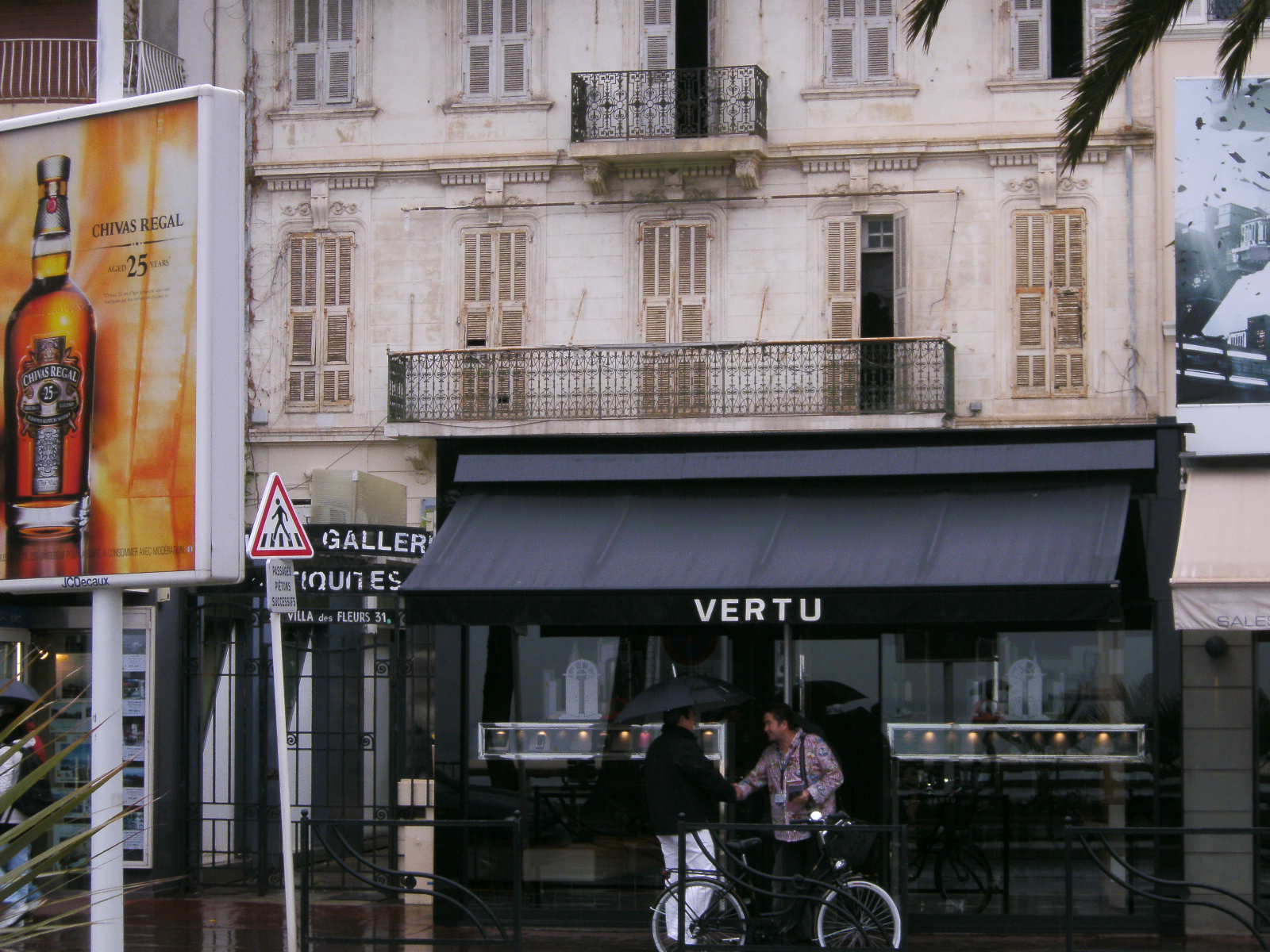
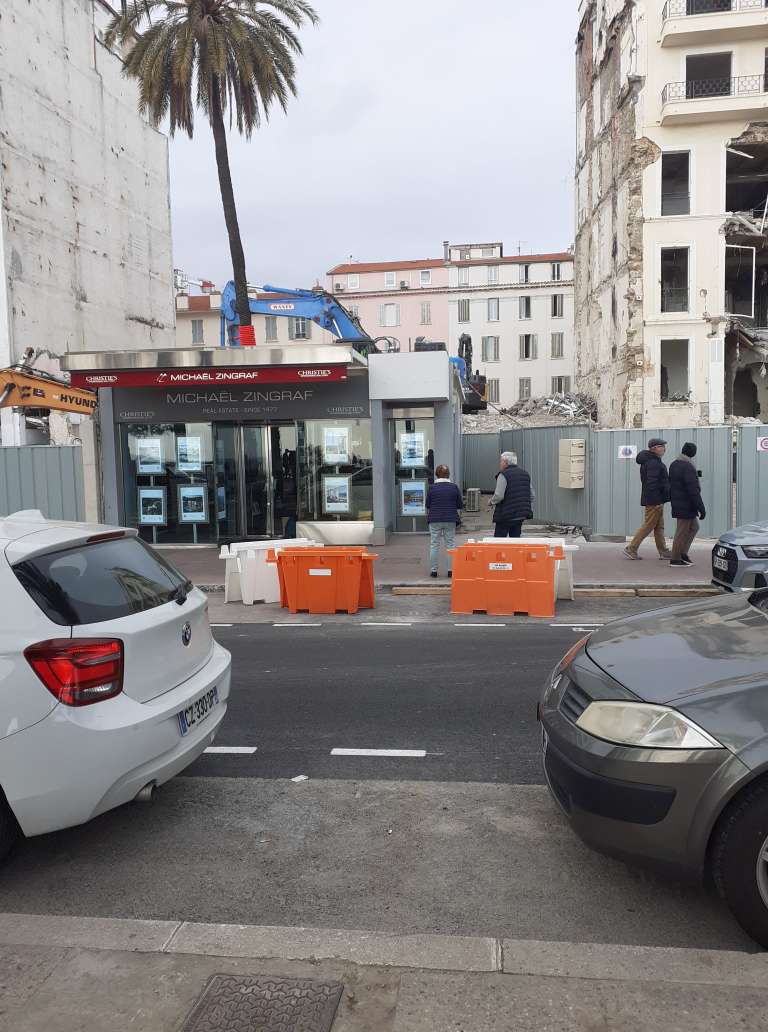
This old block of apartments was once one of the few examples of an older more interesting building along Cannes’s waterfront. There seems little virtue in destroying interesting architecture, especially with original wrought-iron balcony railings, high ceilings, old shutters. But now it’s gone – while Antibes has kept its past.

Except for the Carlton, what historic buildings are left on Cannes’s waterfront? Why not remodel a site like this?

Well they have.

The developer’s sign says the new offering will provide a private treated heated pool for two penthouse apartments – just a hop, step and tiny jump away from the Mediterranean.

Credit where, all hail to..

It is, I assure you, an infuriating mess, a refuge, a joy to behold, an acrimonious cesspool of computerisable angst, an endless checklist of outso(u)rcerized disputes – a hole in the wall for all the world’s minds to filter down onto damaged DVDs. They will in time. And this you will find will be their final resting place.

The staff are miraculous, critically underpaid, limitlessly incompetent, irritatingly profound, delightfully empty, lazified beyond imagining, utterly perfect in their rhombus like cartoon feature creatures silicon graphic simulatoring carnival spirit. They sit there one at a time in that hell’s kitchen like Camusian sentences in utter knowing decrepitude.

If I could ever find the title I crave, the one I have up here, I will throw a week long party for all of you (send me yr contact). As a photocopier – though – to be honest – let’s be fair – my local is the soul of efficiency. As a printer of documents it is besmirchless –

….any fault the computer hard-drives at you is not down to the poor beleaguered impoverished centre.

It is a meeting, as it were or was – point by point – planned, for the perfect silence of minds, brought to life ONLY by murmuring mobile phonies and at least one hundred SE-a-MLESS dialects.

Not a letter I know is transferrable in order to patronise misapplication by default (if you know how to approach it). So…All hail to my local

….– library.

Another Voice for Nam Le

Louisiana Alba is the author of Uncorrected Proof, which I heart, so I asked if she would write something just for me (and you lit-lovers). Here ’tis:

Italians have a phrase: non mettere le mani avanti, don’t put your hands out in front (to prevent the fall you fear). Let the scholars sort out my fictions. I am trading here on memory and instinct alone, a dangerous line, I know, particularly as I was going to do a piece on Windschuttle and other historical fabrications. Do you know Windschuttle? Does anyone care? No? Then, I best leave him for another time.

Nam Le has just won the Dylan Thomas Prize. This is no small prize and no small feat, I said to myself, then realised I was staring at my own. My feet were the only feet in the room. I was intrigued though I confess I didn’t know Nam Le’s work before I went online and ordered the one copy of The Boat held by the British Library. The book of The Boat. The Boat in book form. It says a lot about the focus of readers in London that it hadn’t been snapped up already. After the Booker Prize shortlist was announced every copy of every book the BL had by every writer on the damn list was in use. Hell, what’s going on? I said at the time.

Nam Le, who is he? When no answers came I could interpret I webbed wider to find out more. I came upon: ‘Love and Honour and Pity and Pride and Compassion and Sacrifice’, from The Boat itself. I read the screen-printed story. Even in the twenty-first century I still find it hard to read fiction this way. Yet Nam Le had me hooked with his first words. The Boat had cast me a line. ‘LHPPCS’ is a fine and good story, as Hemingway might have said. I saw echoes, or imagined I did. Thom Jones’s an-American-in-Vietnam stories, what was Nam Le doing here, a parody of memoir technique developed by a writer come writing-teacher in an Iowa writing school? Many stylistic lines from many American short story writers crossed my eye-line, Le skilfully self-addressing the author, wannabe, manqué throughout.

Thom Jones is still on that Iowa program I believe. I have long admired his work and reference him in Uncorrected Proof. Judging by ‘LHPPCS’, I feel no less strongly about Nam Le’s capacities, finding the comments of praise I saw this morning true and right down to the last syllable. Hemingway is an apt voice to mention as well, I suspect, for what happens at the end of ‘LHPPCS’ happens to the Hemingwayequestrian character in The Garden of Eden as well – the writing and story of both characters ending up…No, I can’t say it either.

Let me be frank or… Nam Le. This writing strikes more than one chord, literary and life chords. When I first left Australia, after university and film school, my first assignment abroad was to film a boat full of ex-Vietnamese hitting land in southern Thailand. Pure fate. It was only the second time I had professionally put an Eclair 16mm camera up on my shoulder, only the second time I had used one live full-stop.  As I clambered about the decks of beached boats, sweat running in my eyes, the stench of summer in the Gulf of Thailand all around, somehow I kept the excitement of the waving forms motoring towards me in focus, somehow I maintained the other arrivees close-by in frame, somehow I didn’t end up in that murky Thai seaside drink all sides up. All along I had no idea I would revisit this plot and theme several times in my life.

I move on to Hong Kong filming and producing two more films on escapees from a hell on wheels inside Vietnam, to a fate far worse than the Thai camps, if my olfactory memory of the warehouses along Hong Kong’s Pearl Harbour serves me well. My fourth and last experience is back in Sydney six years later, making a film for Special Broadcasting Service on a need some Vietnamese children developed for writing up their experiences. In a Strange Land, one girl titled her poem, or was it tilted, living out a nightmarish late childhood horror that was Cabramatta, or as some Australians casually called it back then, Vietnamatta. Reading Nam Le brings it all back.

What is Nam Le’s ‘LHPPCS’ all about then? Writing in Iowa? Growing up in Australia? Relationships? Remembering Mum? Revisiting or leaving Vietnam behind? Getting onto livable terms with Dad? Memory in ‘Love and Honour and Pity and Pride and Compassion and Sacrifice’ is a wonderfully cruel trick. We live and die by it along with his character in the same instant. Nam Le’s memoir, the memory of his life’s truths as laid out in fiction, is an examination of a fictionalised ‘ex-Boat person’ narrated in such an unadorned air of truth that if the other stories in the collection are even half as good, then I know in truth I am in for even more of this rare treat.

Can’t wait to see what she says after reading the rest! – LM

Small versus Big, and small must win

ElephantEars Press, my publisher in Hackney, a small, new and independent publishing press dedicated to bringing you good literature, fiction and non-fiction, at fair prices, is now offering FREE post and packing to ANYWHERE in the world.

These holidays ElephantEars Press wants to give readers a real and true deal.

Lately, I have been following Amazon’s attempt to monopolize Print On Demand, to force independent publishers to accept Amazon on terms designed to crush the life out of the independent publishers and booksellers. It’s a disgrace – Amazon only got where it is because readers like you and me helped them become a force. We supported them in the early days because we wanted diversity, because we believed they were for us. Not anymore they aint!

Amazon wants to monopolize bookselling and print on demand publishing. They want to to kill off publishing independents and consumer independence. Don’t let them. Buy from small independent presses like ElephantEars. Support small and ignore the big homogenizers of creative output.

For this holiday, for your gifts – Buy from the small dedicated publishers like ElephantEars Press determined to bring to you reading quality for your pound, dollar, and euro

SUPPORT SMALL against BIG.

Where we are

Linda Nylind
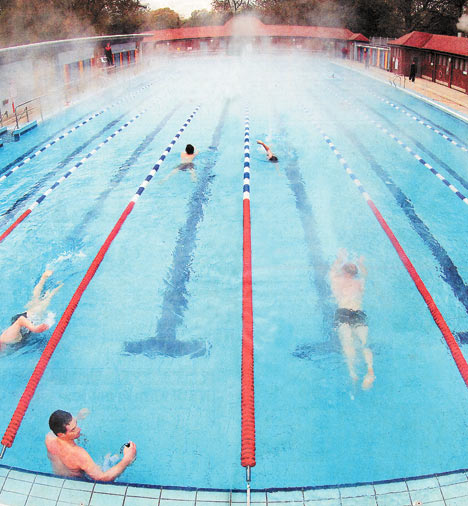
London Fields outdoor Pool - The Guardian. Photo by Linda Nylind

I was doing my 1500 metres in the pool yesterday, lap, swim, turn, lap, roll, stretch, concentrating on my breathing, thinking of what novelist, inventor, academic, Eric Willmot said to me on the phone the other day, talking of his recently written essay on human and planetary survival. I had read the pages he sent me, describing our progress of us all, the twenty third species of human on this planet..the story aint all pretty. Well, I think we know that, but where do we go from here? We seem to be running out of time. Eric is convinced that the global warming we are experiencing is a prelude to another ice age.

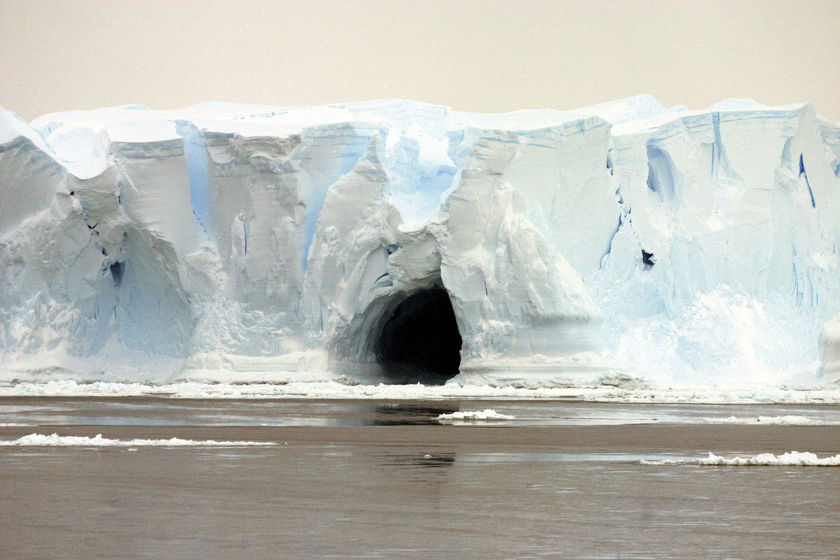
Ice with a black hole - see that's the proof!
Ice Age (with a black hole in it as well!)

Our nearest refuge, that is, nearest to our earthly conditions in toto, is Venus, but that planet is a green house gaseous inferno. So that’s out. Another solar system like our little ‘Goldilocks zone’ around the sun, surrounds the star Gliese 581, but that is twenty light years away, beyond our capacity to reach in all our lifetimes. Without some sort of quantum leap in our capacity to travel, our interplanetary air bus is going to run out of gas, if not time.

And even if we get there Gliese 581 may not be quite for us. It hasn’t sent us any kind of signal, let alone a welcome email they want us over for any holiday coming. We better find out then. We could send the executives of Fanny Mae and Freddi Mac and a few bank presidents, the whole of Wall Street in fact, on ahead to check it out, investigate the real estate and other markets and set up for us. In the meantime, we’ll sit it out and wait down here, glued to the telly for messages, filling our neighbourhoods (and the silent universe) with the sounds of humanity, eating, drinking and getting inordinately merry, all those goings on, as we use up the planet we’re whizzing around on.

Eric has some ideas on what we can and can’t do. Are we facing extinction? Are we staring into the abyss, not so blissfully un-a-ware as impotently more-than-scared? Rabbits in the headlights of some rogue comet or asteroid heading relentlessly our way? What should we do? Recycle our rubbish, turn off our appliances, walk to work, invest in nuclear reactors using Thorium (pronounced /ˈθɔːriəm/ wikipedia tells me).

Well, I think the first thing we should do is get up to speed on the actual conditions, educate ourselves. Get to know our options (even if the picture aint pretty). We’ve faced threats before – Hitler, the Cold War, the nuclear holcaust. Let’s face this one, form neighbourhood groups to discuss intra and interplanetary survival.

Well..okay…let’s do nothing then..just sit and wait and watch it happen. Let’s climb into the warming pot we call this world and boil slowly and then when the fuel burns out, slowly descend down into that big freeze.

Art, commerce and the dizzying world of artifice

I have been trying to get a blogger of note to become a reviewer of note, that is, get to her to do a notice on my book. Or should I say write a note, postice me, no, well notice me in her..well I think you get what I mean by now.

The problem is or was she was taken up with blogging the Hirst thing as he was selling 111 million or whatever pounds worth of what, we don’t really know yet, in the middle of what we’re not sure yet is the second worst (or just the worst) finance mess of all time. I fear the financial bang down on economies and hell only knows what else, all that money stuff that holds us all up in the first and last place has much yet to say.

That Hirst Thing- SuperTouch
That Hirst Thing –  SuperTouch

My own hazy memory of other memories tells me that 1929 was the first big stock market etc crash, but 1931-4 was the real pain that the ordinary bloke felt so keenly, pain the world felt all over. Ditto for 1987, which became 1991-3, when the real ordinary mess that was house values falling down around people’s ears really hit home.

I remember 1987 very well. I was in Sydney and was about to try to sell my apartment, and, a few days before the crash, went to a property auction in the suburb of Bondi Beach to see what I could possibly do, auction or straight sell. That auction day was a scene from Fellini. It was dizzying mad, like nothing I had seen, people shouting over each other to buy huts and hovels for double and treble their one day prior worth. Perhaps I exaggerate the doubling and trebling but that was what it felt like being packed into that auction house room.

Bondi Beach
                         Bondi Beach – by Pio Carlone                                            

At that time the king of all things moneyed down under, particularly the market gambling sort, was a one Robert Holmes a’ Court, greenmailer and white knighter extraordinaire, who became Oz’s first billionaire. He was richest but still (unofficially) vying for the title of most wealthy man in Oz, fighting with two redoubtable dark nights and media souls, Rupert Mudoch and Kerry Packer, for the privilege, probably, I guess, because he came from the West not the East. But all up before the 1987 crash Holmes a’ Court was worth 2 billion dollars, a tidy sum even today, and from reports of Hirst’s worth, enough to buy him out twice over.

And Robert Holmes a’ Court – like that other Robert from Oz, Robert Hughes, the bloke that Hirst doesn’t too much like apparently – was a lover, no, a connoisseur of Art. I say Art with a capital, because Robert Holmes a’ Court was into ART in a big way. A horse lover, a stocks gambler, he also bought into the big and small art stables. He bought and supported big and small names. And one of his stable of small names was a one Paula, an artist I knew in passing. Paula created holograms, a pioneer of minor reputation in a part of the world that by geography alone diminishes the adjective minor to very very small in the world of ART – her end of it, at least. She told me about her brush with Robert.

Those who know what happened in 1987 will remember the face of Robert Holmes a’ Court standing at the glass wall of an upper floor overlooking the Sydney Stock Exchange that day his fortunes went a little too far south for his liver to digest. His face was a newsprint picture, financial grief of power disappearing faster through him than a bad curry. Post crash, when the bits stopped falling, when the exchange chit dust cleared (long weeks on after much gnashing of teeth, wringing of hands, and of course, horse trading), he was worth 600 million, not too bad either even for a mogul today. He devoted himself to other matters thereafter, his horse stud, his art and perhaps some charity if I remember well.

Paula told me how he arranged to see the work she had been doing under his patronage some days after his catastrophic crash – he was dead in three years, at 53. She described a distracted figure walking into her studio and standing trying to get his head around what she was doing, trying to fathomize what she was telling him (and Paula could tell you at twenty fathoms). The world of finance had done his head in. Getting his mind in a grip with tiny green hologrammed figures was beyond him. Robert stared at one of her projections stuck out in thin air. ‘But it’s so small,’ he said and left without another word. And that was it for Bob and ‘er, the last Robert H. a’ C. dollar she ever saw.

Paula in her studio
Paula in her studio – COFA

Now no one could say that Hirst’s work is tiny in the way that Paula’s experiments were back then. And what with that artistic industry of so many hands, his tanking of animals in preservative somehow brings Holmes a’ Court’s newsprinted face to mind, this apparition of a human staring at this watery cow, and turning to an assembly of art gamblers I see him trying to say something. Only I can’t hear him against all the clamour of bidding. Was it, what’s next Damien, the white elephant? No, that’s what I would say. Was it something about it all being so small? No, that cash cow aint tiny. I’m still looking, trying to read his lips as they disappear into the thin air of  a reconstruction of a long-lost auction room  – moments, ethereal elements caught up in a hologrammed memory – along with a good part of the world’s financial infrastructure, coming soon to a leaky tank near you, not to mention that review of my book, Bob H. a’ C ., his horses and Paula, my apartment, the diamond encrusted prices a Russian miniature oligarch saw fit to pay for a Hirst tanked up thing – all those mad, dizzying seconds.