“Was Life Simpler Back Then?” Vol. 2. Opening arguments.

Novelists don’t write alone. The unconscious does the heavy lifting. While conscious, many writers can be like stenographers with a flair for editing.

What we say about ourselves consciously in the life writing or self histories has always to be viewed sceptically. An insight that seemed to me profound hearing it many, many years ago: it’s not what we put in diaries that counts. It’s what we leave out.

Does the unsaid in life writing count for more than the said? Some people are remarkably honest about themselves, but would I consciously leave out things in any life writing? Yes.

Autobiography is too self-aggrandizing. Fiction is more fun to do. Fiction frees up writers to find and tell truths he/she wouldn’t admit to when writing about themselves.

Out of Competition and Democracy

Grifters, sharks, wannabes, liars, creativors cruise the seaside Promenade as an enfranchising of an entire festival grows out of protest, taking voting from annual juries and giving it to the fans, without whom the festival would not be.

When I was writing this the second invasion of Ukraine hadn’t happened. When I was in the the final draft oligarchs lived only in Russia. Now they’re hard at gaming America. When I was in the final draft, political sycophancy was in its infancy now it’s fully grown.

When I was in the final draft there was still an operational Democratic Party, now a couple State governors are performing CPR on its seemingly lifeless body. When I began writing this most of America believed in habeas corpus, personal and civil rights, accountability and independence of the judiciary.

When I was writing this novel it wasn’t clear how much damage the right wing of the Supreme Court could inflict on America.

Is American democracy at death’s door …..

The No Kings Protest, and then what happens..

Plage de la Garoupe

In Antibes after the heavy rains and walked out to the beach where Picasso, Hemingway and the Fitzgeralds swam.

With debris on the sands, and the clear air and snow on the alps over the water, it was cold and wonderful. No one else went out. Nothing like winter waters and history all to yourself.

Lee, JFK and Stephen King

It’s tough being a writer in this organised politically-controlled oligarchic world of ours. Publishing is a strategic asset in a stable of assets essential to a well-tuned oligarchic universe. The message, whatever it is, must be edited. That seems to be the last law of the universe, the one Scientists haven’t yet owned up to.

Try thwarting it and you will be edited out of existence says a footnote on the first page of the Oligarch’s Manual. Try beating the system and your Sun will shine no more.

So, I guess even the great Stephen King obeys this largely hidden law of our Oligarchic Universe. (I say great because book sales obviously equate with greatness, right?) It has nothing to do with well-oiled sales machines. Sales = Greatness and vice versa. So, I went, I must say with hope, to read 11.22.63 by the undoubtedly great Stephen King. And what did I find? Well, my mother always said: if you can’t say anything nice don’t say anything at all. But when did I ever listen to my mother?

What on earth was King thinking about?

Not the truth clearly. His novel is fiction, okay I get it. Only he put an awful lot of real people in it as well. Like poor old Lee Harvey. Poor old very dead and much maligned Lee Harvey Oswald. A feckless man and near hopeless rifleman who some people keep saying was guiltier than his own much imagined sin. Lee Harvey Osward with his Carcano Model 91/38 rifle with which he probably couldn’t have hit a barn-door from 100 metres. No, not probably, maybe definitely. The man who somehow reverse-actioned Newtonian physics—with that minor impediment of a tree blocking-out his vision—hitting a moving target from the wrong direction.

From how far was it?

The man who ended in history as being responsible for killing a President. Go figure. Many have tried. I don’t need to debate this anymore. To my mind at least, if Lee were on the sixth floor of the Book Depository that fate-filled day and fated time and was pointing a rifle at the back of the President’s head, he would have had more chance of hitting Parkland Hospital, than as is claimed, he murdered JFK, in the still so far un-investigated—at State Law level—crime of homicide.

The make-believe myth come mystery in Dallas, 22 November 1963.

All now co-signed by bestselling-author Stephen King.

One Writer’s Journey

I grew up watching Superman, The Cisco Kid, O.S.S., hearing war stories, chasing down moth-eaten army uniforms back when milk arrived in a horse and cart marvelling at the colour style of actual coca leaf sugarpop in Coke bottles blinking at motor cycles Dick Van Dyke falling over a couch cowboy films shot in daylight B/W then coloured nights of my father’s home-grown vegetables, born with words in my mouth – ‘gimme-that’ , ‘how-dare-you’,  ‘what-the-fuck’ –

– ideas as fixed and eternal as the motives for every war, growing into Kidnapped bicycles desert boots Seventy Seven Sunset Strip Disney Land Rear Window Psycho Lawrence of Arabia, the annual anxiety of packing the car at holiday time, each and every moment stilled in memory of the forever mysterious parodies of life or art even if parodies weren’t even an option back then. I knew the Beatles before the Monkees, Bogart before Belmondo, but I can’t say I recall the idea behind the Summer of ’42 before it was a film conjured into a Mad magazine parody or whether it co-existed in the smash crash and kill dinky toy mind of George W. Bush. I believe I’m not alone, even growing more bewildered year on year by the incoherence of images and texts surrounding me from birth arresting my natural river environment in the far southern climes the commercial and cultural ink-blotting over my childhood my natural world a parody of some story my mother told me, those seconds on a baked sidewalk hearing JFK was dead, pink socks on the rock ‘n rollers, moments things events sounds sent to make life even more dangerous curious frightening, a direct result of the industrial military complex, Elvis Presley Chuck Berry even, the jack shit political influences beaten into the worrying shame of death in the world, prejudice, organically connected and woven into a general valueness held dear by so many years on from that day when morality was gunned down in broad daylight.

Sammakon in Turku

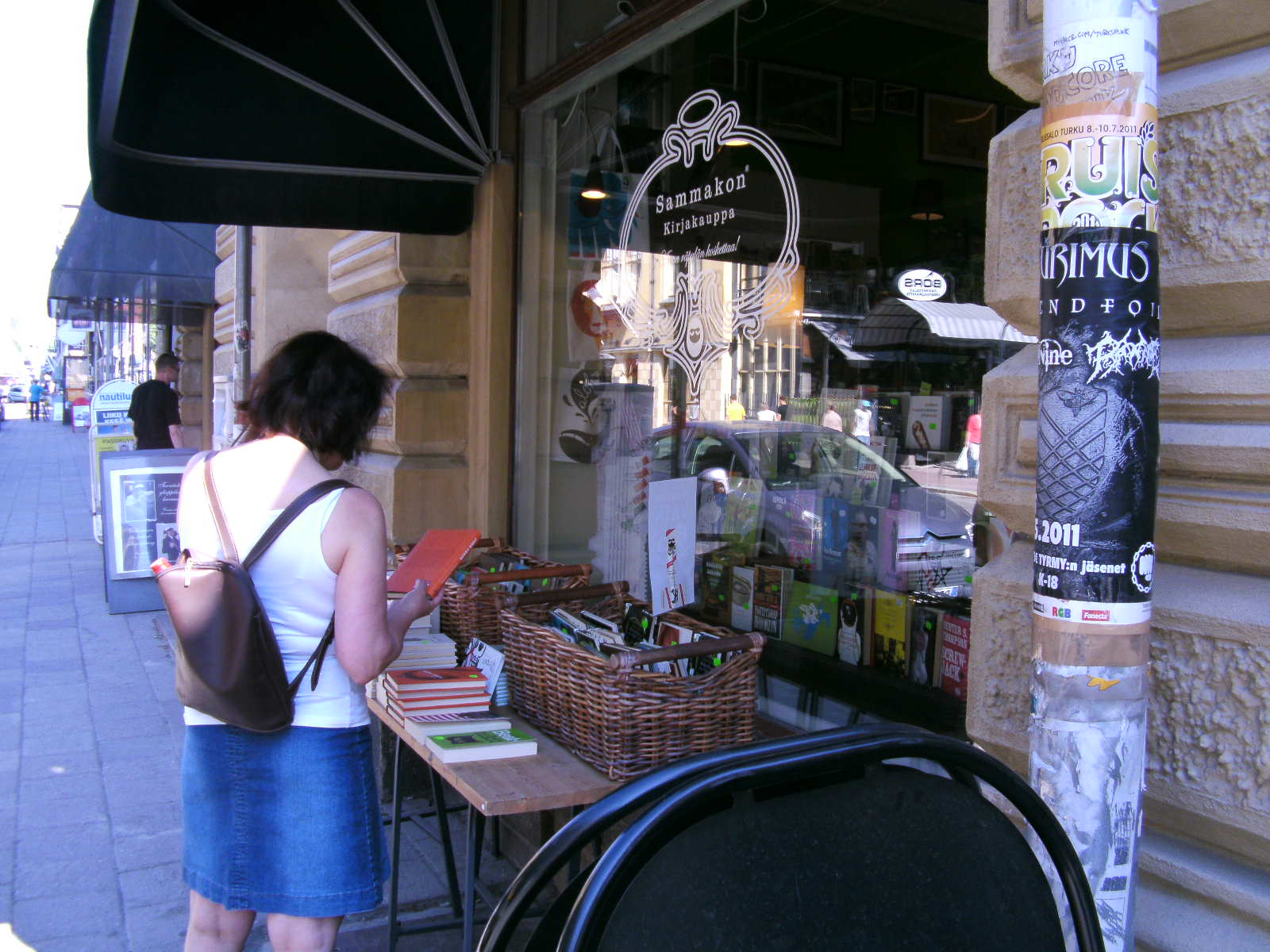
I was in Finland last week, in the western city of Turku, facing down five days of clear blue skies and 30 degree sunshine, weather Londoners can only dream about. Turku is a friendly, gentle-paced city.

I found a bookshop not far from the hotel.

What caught my eye right away was a small John Fante hardcover in Finnish lying on an outside table, selling for 3 euros.

No dumping books in remainder shops, not in this corner of the bookworld anyway. There it was at a price anyone can afford – with the added value of being in translation. Sammakon is not an average bookshop, even if it could be mistaken for one at first glance.

There are two sammakko.com shops, the other in Helsinki. Sammakon’s owner publishes, sells and translates from English himself, especially his favorites – Bukowski, Fante, the beat poets and novelists. His first book was a translation of Charles Bukowski’s The Days Run Away Like Wild Horses Over the Hills. And don’t they just. After coming across this minor miracle for the world of books in English, one that so intimately caught my eyes, all both of them, it was on the bus for the drive back to Helsinki, for a day and a half of restaurants and walks, before flying back to rainy, chilly London.

Let’s Bet on Independents

Borders is dead, long live the independents.

When Borders came into the UK and bought up Books etc, what happened? A superb small bookshop chain that knew what it was doing slipped out of sight. We know what BIG can do. It goes bust with a BANG in bad times, well, a dull thud in this case.

Do we get the message? BIG doesn’t work in tough times. So why not support the people who are there for us with books year in and year out.

In my area there’s ONLY one – Stoke Newington Bookshop – owned and run by Jo for the last twenty-two years. She’s seen whole families of readers grow up, took over the floor space when Barclays moved out..remember that? A bit before my time. Jo has weathered rent rises, publisher and writer collapses, buyers and banks coming and going.

It’s a superb shop, one of the best book table layouts I’ve ever seen. If you are a  reader who likes to book-browse without pressure this is the shop for you.

Stoke Newington Bookshop 159 Stoke Newington High Street, London, N16 0NY (near the t-junction with Stoke Newington Church Street)


It’s enough to be in Paris

BILD2186


I went to Paris for my birthday (had to say it at least once). Found a wonderful hotel, with the sort of market just two minutes away you can only find in France. Combination of food on sale and items and atmosphere. Checked the book in Shakespeare and Co. Have a look, too – Uncorrected Proof, under A for Alba.


BILD2132

BILD2070
BILD2080

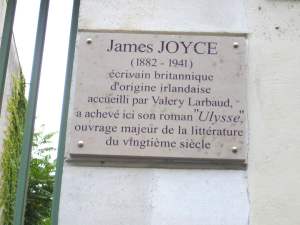
Walked the streets. Passed through, open-mouthed, the commercial alleys of the left bank. Should manic tourism do this to such a brilliant part of the city? Up and away through Montparnasse, by the Pantheon and back down by Joyce’s home (one of 13 while he was in Paris).* I  just found the address without any idea where it was, wasn’t even thinking of him. Now I’m asking myself what are the chances of chancing on it in a city the size of Paris.


BILD2123

Not one for tourist plaques or gravestones but this is worth lingering by.


BILD2177

Really didn’t do all that much in two days –  didn’t lunch or dinner at expensive restaurants, didn’t even tea or coffee in les deux magots. Just absorbed the sounds and sights from train to train. It’s enough to be in Paris.


BILD2159BILD2113
BILD2116

* As the New York Times tells us, it was Joyce’s “prettiest place…Valery Larbaud’s apartment in a kind of mews at 73 Rue Cardinal Lemoine, on the Contrescarpe behind the Pantheon and with curving view of Paris.”

Another Voice for Nam Le

Louisiana Alba is the author of Uncorrected Proof, which I heart, so I asked if she would write something just for me (and you lit-lovers). Here ’tis:

Italians have a phrase: non mettere le mani avanti, don’t put your hands out in front (to prevent the fall you fear). Let the scholars sort out my fictions. I am trading here on memory and instinct alone, a dangerous line, I know, particularly as I was going to do a piece on Windschuttle and other historical fabrications. Do you know Windschuttle? Does anyone care? No? Then, I best leave him for another time.

Nam Le has just won the Dylan Thomas Prize. This is no small prize and no small feat, I said to myself, then realised I was staring at my own. My feet were the only feet in the room. I was intrigued though I confess I didn’t know Nam Le’s work before I went online and ordered the one copy of The Boat held by the British Library. The book of The Boat. The Boat in book form. It says a lot about the focus of readers in London that it hadn’t been snapped up already. After the Booker Prize shortlist was announced every copy of every book the BL had by every writer on the damn list was in use. Hell, what’s going on? I said at the time.

Nam Le, who is he? When no answers came I could interpret I webbed wider to find out more. I came upon: ‘Love and Honour and Pity and Pride and Compassion and Sacrifice’, from The Boat itself. I read the screen-printed story. Even in the twenty-first century I still find it hard to read fiction this way. Yet Nam Le had me hooked with his first words. The Boat had cast me a line. ‘LHPPCS’ is a fine and good story, as Hemingway might have said. I saw echoes, or imagined I did. Thom Jones’s an-American-in-Vietnam stories, what was Nam Le doing here, a parody of memoir technique developed by a writer come writing-teacher in an Iowa writing school? Many stylistic lines from many American short story writers crossed my eye-line, Le skilfully self-addressing the author, wannabe, manqué throughout.

Thom Jones is still on that Iowa program I believe. I have long admired his work and reference him in Uncorrected Proof. Judging by ‘LHPPCS’, I feel no less strongly about Nam Le’s capacities, finding the comments of praise I saw this morning true and right down to the last syllable. Hemingway is an apt voice to mention as well, I suspect, for what happens at the end of ‘LHPPCS’ happens to the Hemingwayequestrian character in The Garden of Eden as well – the writing and story of both characters ending up…No, I can’t say it either.

Let me be frank or… Nam Le. This writing strikes more than one chord, literary and life chords. When I first left Australia, after university and film school, my first assignment abroad was to film a boat full of ex-Vietnamese hitting land in southern Thailand. Pure fate. It was only the second time I had professionally put an Eclair 16mm camera up on my shoulder, only the second time I had used one live full-stop.  As I clambered about the decks of beached boats, sweat running in my eyes, the stench of summer in the Gulf of Thailand all around, somehow I kept the excitement of the waving forms motoring towards me in focus, somehow I maintained the other arrivees close-by in frame, somehow I didn’t end up in that murky Thai seaside drink all sides up. All along I had no idea I would revisit this plot and theme several times in my life.

I move on to Hong Kong filming and producing two more films on escapees from a hell on wheels inside Vietnam, to a fate far worse than the Thai camps, if my olfactory memory of the warehouses along Hong Kong’s Pearl Harbour serves me well. My fourth and last experience is back in Sydney six years later, making a film for Special Broadcasting Service on a need some Vietnamese children developed for writing up their experiences. In a Strange Land, one girl titled her poem, or was it tilted, living out a nightmarish late childhood horror that was Cabramatta, or as some Australians casually called it back then, Vietnamatta. Reading Nam Le brings it all back.

What is Nam Le’s ‘LHPPCS’ all about then? Writing in Iowa? Growing up in Australia? Relationships? Remembering Mum? Revisiting or leaving Vietnam behind? Getting onto livable terms with Dad? Memory in ‘Love and Honour and Pity and Pride and Compassion and Sacrifice’ is a wonderfully cruel trick. We live and die by it along with his character in the same instant. Nam Le’s memoir, the memory of his life’s truths as laid out in fiction, is an examination of a fictionalised ‘ex-Boat person’ narrated in such an unadorned air of truth that if the other stories in the collection are even half as good, then I know in truth I am in for even more of this rare treat.

Can’t wait to see what she says after reading the rest! – LM