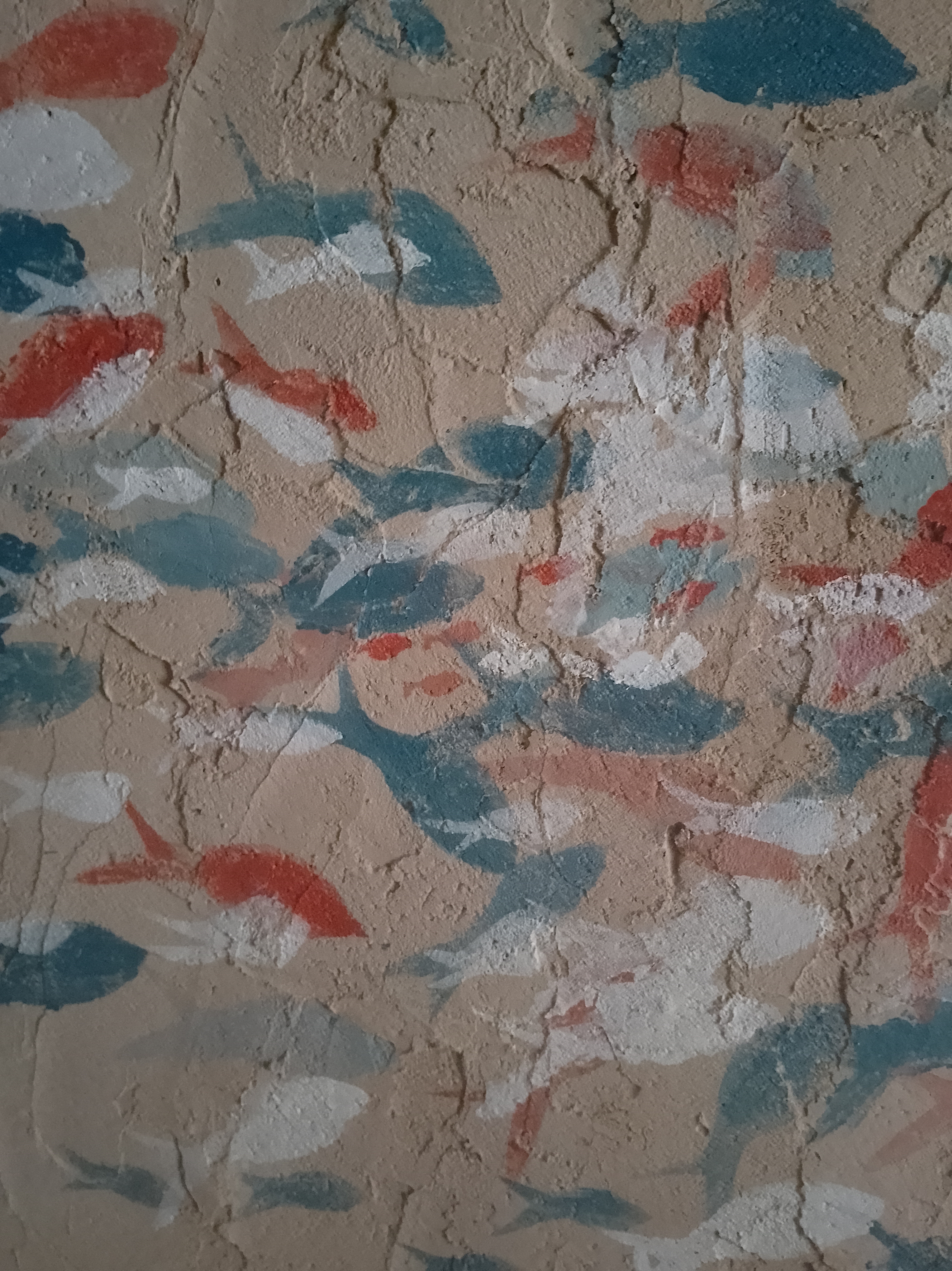
Looks as if I painted this mural on a beach in between waves, or after the tide just went out.
Lime plaster is a wonderful rendering to give a wall. The plaster breathes and deals with any moisture. It’s antibacterial, anti-mold, and the insects hate it.
by Austin Williams, Director of The Future Cities Project
It is fifty years since Spielberg’s movie, Jaws, first reached the big screen. It was described by film critic, Mark Kermode as a “genre-defining blockbuster that changed the face of modern cinema.” Indeed, a new theatre production, The Shark Is Broken, reflecting on the making of that movie is playing in UK theatres today. Lew Collins’ new book “Out of Competition” makes a few nods to the film – one of the characters is proposing yet another remake of the Jaws franchise – and to film-making per se, in a novel of intrigue, murder, and protest set in the murky world of international-finance in the film industry. Within the first chapter, a motor-boat driver is killed by a real shark falling from a promotional helicopter stunt. And so it begins.
The story is told in chronological order, day by day, over the course of a Film Festival in the south of France. A central protagonist Larry Linsteeg, a failing Hollywood film producer, kicks things off and within the first few pages we see him manhandled in a street in the south of France and bundled into a rowdy, radical, pro-democracy meeting. He’d been on his way to close a film-deal, and this opening chapter is fast-paced, and scripted in a manner of a Tarantino-esque film-edit. And equally confusing.
This book has been acclaimed as the 2023 Kenneth Patchen Award-winner (a prize celebrated by the Journal of Experimental Fiction). The author, Lew Collins relocated to France several years ago and his love of the country and especially its language comes across in the text that mixes French language freely into the dialogue. Maybe it’s a little too much for this GCSE-level reader. I found myself reaching for the Google Translate app across several paragraphs (but perhaps that says more about me than the average reader).
Adding to the need for concentration while reading this book, a number of characters appear with few flags or signature and we are confronted by a growing cast in rapid succession: a dodgy Russian oligarch, a film correspondent, a freelance photographer, a chief inspector, an ex-KGB agent with a heart condition, an outgoing festival director, critics, journalists, billionaires and showgirls. Along the way, there is a disappearance and a murder; there are Chinese kickboxers, Japanese artists and leftist demonstrators. It’s a lot for the reader to take in, and it is clearly a strain in the author’s character-naming inventiveness; culminating in Semolina Pynes, the out-of-her-depth, lead actress; or Zena Zatters, the festival gofer. Where characterisations are made, they are a little laboured, for example, sign-posting the “LA-based American audiovisual expert and putative film producer” or describing the oligarch’s boat as “a three hundred and twenty foot welded steel and aluminium moulded fibre-glass… ocean-going, part-solar-powered ship cruiser.”
That said, the story settles, and intrigue ensues. With so many characters, they rise and fall, appear and disappear all too easily and it is hard to relate to the characters in sufficient depth. But the pace is cinematic. Indeed, the filmic ambitions of the novel seem to have drawn characters from movie references: I pictured Rollergirl in Boogie Nights, or Alain Delon in La Piscine, and one can imagine a script for the big screen that emphasises the “homage“, as they say in France, towards updated Bogart detective noir. Maybe even a hint of Get Shorty… about a loan shark after all.
“Out of Competition” by Lew Collins, Jef Books, 2024. pp407.
I am a writer, novelist, living and writing on the south coast of France, where I swim and continue renovating my apartment.
I am very close to finishing a novel set in 1963. My recently published novel Out of Competition, published by JEF Books, Illinois, October 1, 2024 won the Kenneth Patchen Award for the Innovative Novel.
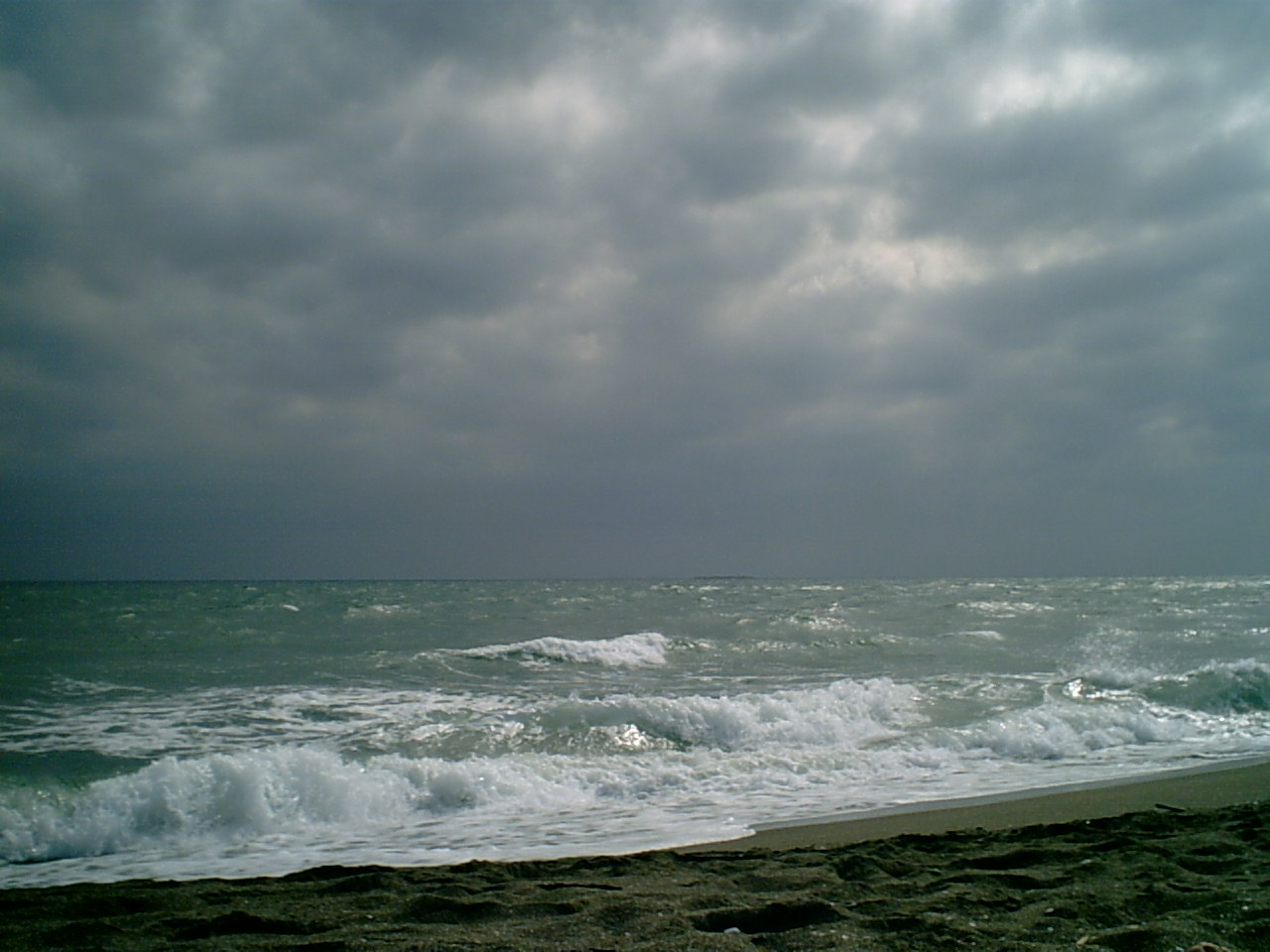
In Antibes after the heavy rains and walked out to the beach where Picasso, Hemingway and the Fitzgeralds swam.
With debris on the sands, and the clear air and snow on the alps over the water, it was cold and wonderful. No one else went out. Nothing like winter waters and history all to yourself.
Went swimming today and saved a bird caught in a net.
Fishing nets are not just traps for fish, especially those close to shore. These nets are not big, about thirty metres in diameter. They are dangerous. An off-the-rocks rod-fisherman recounted to me once how a swimmer drowned getting caught in a net like these.
Down for my morning swim, starting as usual from some rocks, a groyne, a small set of boulders off Cannes, where I usually head off from, looking out I saw fishermen had placed one of those nets.
Something was flapping, birds circling above. I thought: they are waiting for the flapping thing to die. When it flapped again, a wing went vertical. I saw it was a small bird, my first impression at first glance, its head seeming to be down in the sea. When it managed to bring its head up, I knew it was very badly stuck.
I swam out to get a closer look, being careful not to get too close to the transparent closely-woven plastic netting. I saw the bird was not small. It was a Cormorant, and it started flapping more the closer I got. When I swim, I go across towards another set of rocks and come back and that’s me done for the day. And usually I stay well away from nets. Today though I couldn’t just leave this bird in this state.
It was completely entangled from its beak all the way down. Treading water I began trying to disentangle it. With the Med colder in late winter temperature coming spring it would not be long before I got really cold doing this, which could lead me to do something silly, like get myself pecked by the bird. I felt sure given the chance it might use its powerful beak on me.
I needed to organise this. I swam to shore where a cafe-bar sat on the sands. I asked if I could borrow some scissors. The guy immediately went and got a pair. Swimming out again I saw another swimmer was in the bay so I enlisted his help and we swam together to help the stricken bird. First up, I got my toes caught up and then the scissors entangled. So it wasn’t a great start.
The other guy used the scissors better than me, so while I held the lines, eventually we freed the bird from the overall net. But the Cormorant was still not free from all the netting. It was well and truly entangled. So we swam it towards shore disentangling as we swam and avoiding beak attacks.
On to the beach, I held the bird up. He cut more. Two women approached and showing more understanding than either of us could muster, they got control of the bird by first gently grabbing its neck. The other woman held onto its body. I thought to myself: women are more practical.
We got the netting off and the bird flew into the sea without a backward glance. I gave back the scissors and went on swimming.
I didn’t last long. I was really cold by now. I cut it all short. I didn’t want to get cramped up. It made me realise that if you were unlucky enough to be trapped out in the sea for some reason getting cold, couldn’t keep moving, you would soon get hypothermia.
This is an all’s well that ended well story. I’m glad I didn’t swim on by. I have seen Cormorants from the rocks swimming at breakneck speed underwater chasing fish coming up to stare warily at me, the human. I hope if and when this one comes back one day it’ll nod in recognition of the moment we shared.
When I started my swimalog I thought at the the time I could document the mental processes, thought patterns throughout long(ish) swimming sessions, that’s what I planned anyway.
Q: So you haven’t been successful?
Not if you look at the number of blogs dedicated to swimming, no.
Q: Was it too hard for you?
The long swims were hard enough by themselves but then when I got swim-fit enough I found it wasn’t because it was hard to think and swim, just hard to remember afterwards what my mind was actually thinking while swimming, and the fact a lot of what I did think was banal – like lap 22, lap 23, lap 25, hang on it that was 24 or was it etc. When you cruise you lose track, when it’s hard you are absorbed in muscle fatigue and aches etc and when is this going to end. You might think of a phrase of music that repeats over and over and that goes on in the background of other thoughts or sometimes even how hungry you are, or just how easy it seems, as you try to concentrate on reaching out your fingertips, keeping your kick to minimum but existent – we’re talking freestyle here – as you just roll on to lap ends and turns and roll and turn and head on into the next lap and getting through it all. Some days are great, some not so great – banal, as you can see. There are many concerns that run through your mind as well, but the thoughts are fleeting and are lost by the swim’s end. One thing though, the harder it gets, the closer you get you get to the end, the more you are concerned with the physicality of it all – perhaps a precursor of final days concerns in any life.
Q: Okay that’s internally. What about externally – other people? Is it better some days than others?
Better when it rains and the pool empties. Way better.
Q: So you learned, one, that swimming highlights an anti-social side in you, and two, you were forced to give up on the original idea – pretty good progress.
Thanks. I branched out in the blog into other topics to keep myself and potential readers interested. And I’m not anti-social, though I accept swimming has a solitary side to it. On a bad day I have managed the occasional rant about pool etiquette with someone who looking back may or may not have deserved it – there are two sides always to these sorts of disputes – but I’m well and truly over that. Swim and let swim is my motto now.
Q: So failing yourself and others you learned something of a better way of handling social relations and conventions. But on your main goal, in well over two years of lukewarm attempts, you failed miserably. You set out to observe and not having the stamina to maintain the observatory technique or even capacity to reinvent a charting of the banal progress of an ordinary swimmer’s daily routine, you gave up. And made no friends.
Thanks. I made one or two friends, a few acquaintances as well. On the observation, you try it, see how far you get.
Q: I didn’t start this idea, you did. So what’s next?
Keep on keeping on. Maybe I will find a way to observe and recount a swimmer’s progress eventually. But in defence of my efforts, it’s a little like writing dialogue – slavish recounting of ‘everyday normal discourse’ rarely makes for good dramatic dialogue, or readable material – ditto for any blog on the mental processes while swimming.
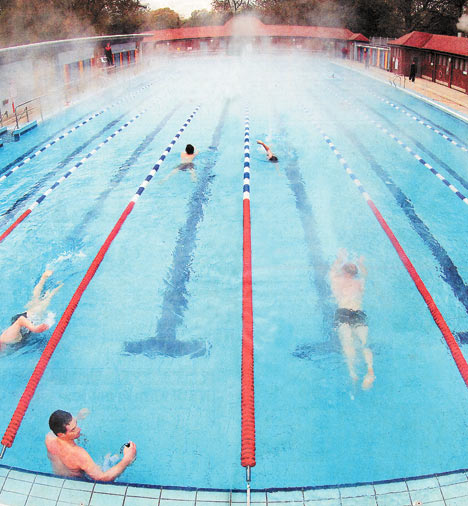
London Fields outdoor Pool - The Guardian. Photo by Linda Nylind
I was doing my 1500 metres in the pool yesterday, lap, swim, turn, lap, roll, stretch, concentrating on my breathing, thinking of what novelist, inventor, academic, Eric Willmot said to me on the phone the other day, talking of his recently written essay on human and planetary survival. I had read the pages he sent me, describing our progress of us all, the twenty third species of human on this planet..the story aint all pretty. Well, I think we know that, but where do we go from here? We seem to be running out of time. Eric is convinced that the global warming we are experiencing is a prelude to another ice age.
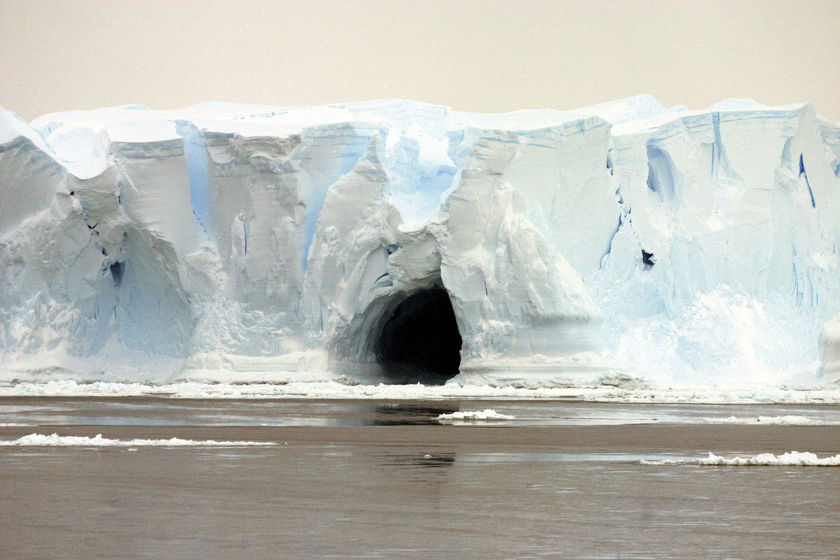
Ice Age (with a black hole in it as well!)
Our nearest refuge, that is, nearest to our earthly conditions in toto, is Venus, but that planet is a green house gaseous inferno. So that’s out. Another solar system like our little ‘Goldilocks zone’ around the sun, surrounds the star Gliese 581, but that is twenty light years away, beyond our capacity to reach in all our lifetimes. Without some sort of quantum leap in our capacity to travel, our interplanetary air bus is going to run out of gas, if not time.
And even if we get there Gliese 581 may not be quite for us. It hasn’t sent us any kind of signal, let alone a welcome email they want us over for any holiday coming. We better find out then. We could send the executives of Fanny Mae and Freddi Mac and a few bank presidents, the whole of Wall Street in fact, on ahead to check it out, investigate the real estate and other markets and set up for us. In the meantime, we’ll sit it out and wait down here, glued to the telly for messages, filling our neighbourhoods (and the silent universe) with the sounds of humanity, eating, drinking and getting inordinately merry, all those goings on, as we use up the planet we’re whizzing around on.
Eric has some ideas on what we can and can’t do. Are we facing extinction? Are we staring into the abyss, not so blissfully un-a-ware as impotently more-than-scared? Rabbits in the headlights of some rogue comet or asteroid heading relentlessly our way? What should we do? Recycle our rubbish, turn off our appliances, walk to work, invest in nuclear reactors using Thorium (pronounced /ˈθɔːriəm/ wikipedia tells me).
Well, I think the first thing we should do is get up to speed on the actual conditions, educate ourselves. Get to know our options (even if the picture aint pretty). We’ve faced threats before – Hitler, the Cold War, the nuclear holcaust. Let’s face this one, form neighbourhood groups to discuss intra and interplanetary survival.
Well..okay…let’s do nothing then..just sit and wait and watch it happen. Let’s climb into the warming pot we call this world and boil slowly and then when the fuel burns out, slowly descend down into that big freeze.
I caught an online Oprah Winfrey interview with Cormac McCarthy. Having only read No Country For Old Men I was and still am a little surprised by all the fawning atttention, but then traced his writing history and found Suttree (1979) .. “the novel’s evocation of Joyce’s masterpiece, Ulysses, is often palpable”. How many writers did Joyce influence? I have lost count of the readers who say they cannot read Joyce, do not like him, yet on literary writers of the 20th century alone Joyce’s influence is always there somehow in some way in their work. Until I hear something that dismantles my view, I think I can say quite confidently that Joyce must be the most influential writer on writers to ever have been so disliked by readers.
Take the left leg, place at right angles to the hypotenuse of the trunk, then swing it high past the ear and down round the other ear. At the same time taking care not to bite the tongue completely away from the back of the mouth or crush the odd molar, bring the right leg round the other way in more or less the same manner and then jump. It should work.
Hopefully you’ll land in the pool. Then follow with 1000 metres of whatever stroke you can manage.
Checked the ticker out with the local quack, seems it’s okay so after slowing to a crawl, (anxiety had me going: oh shit not me heart), I’m somewhat relieved. I’ve moved back up from half the distance, half the pace, back to 1500 metres almost at a decent clip. There’s something about the pool that gets the head right.



 Swimanög