Writing OUT OF COMPETITION – part one: the idea

Out of Competition began as an idea in 2000. It was written in France. Attending a French film festival I saw a film producer grandstanding his way through a series of well-constructed lies. Present that day in a film tent, I thought to myself: this guy needs analysis. At the same time, the recently-ended Soviet Union was embarking upon an economic march over to join in with the West.

Pencilling down ideas I came up with a couple of sketchy characters, one American, one Russian, similar and unique – types who wanted attention, enjoyed power, and were destined to meet, maybe do business together.

Other ideas and characters came into my head as a story began shaping up, but I couldn’t find a central idea to unify everything.

As the novel’s progress slowed my idea faded into the background. Where to begin and what is this about stalled me. I moved on to writing two other books and stopped thinking about the film tent inspired idea. Then in 2010 I read the translation of War and Peace by Richard Pevear and Lara Volokonsky. Hooked immediately, I read it once, then twice.

The translating team’s stated intention was to return War and Peace to Tolstoy’s original Russian language style. It was time. A series of English translators had turned Leo Tolstoy into a copy of a 19th century English novelist. The now well-known Tolstoy test: “The children rode the chairs to Moscow” showed Tolstoy not mutating chairs into carriages. Tolstoy’s children needed no linguistic bridge for their imagination. Pevear & Volokonsky understood this clearly, and translating simply, translated Tolstoy carefully following the original Russian of W&P. Bursts of French appeared again. Then the French culture and language influencing Russian life were torn asunder when Napoleon invaded in 1812.

I had my novel’s subject: Russians invading a French film festival.

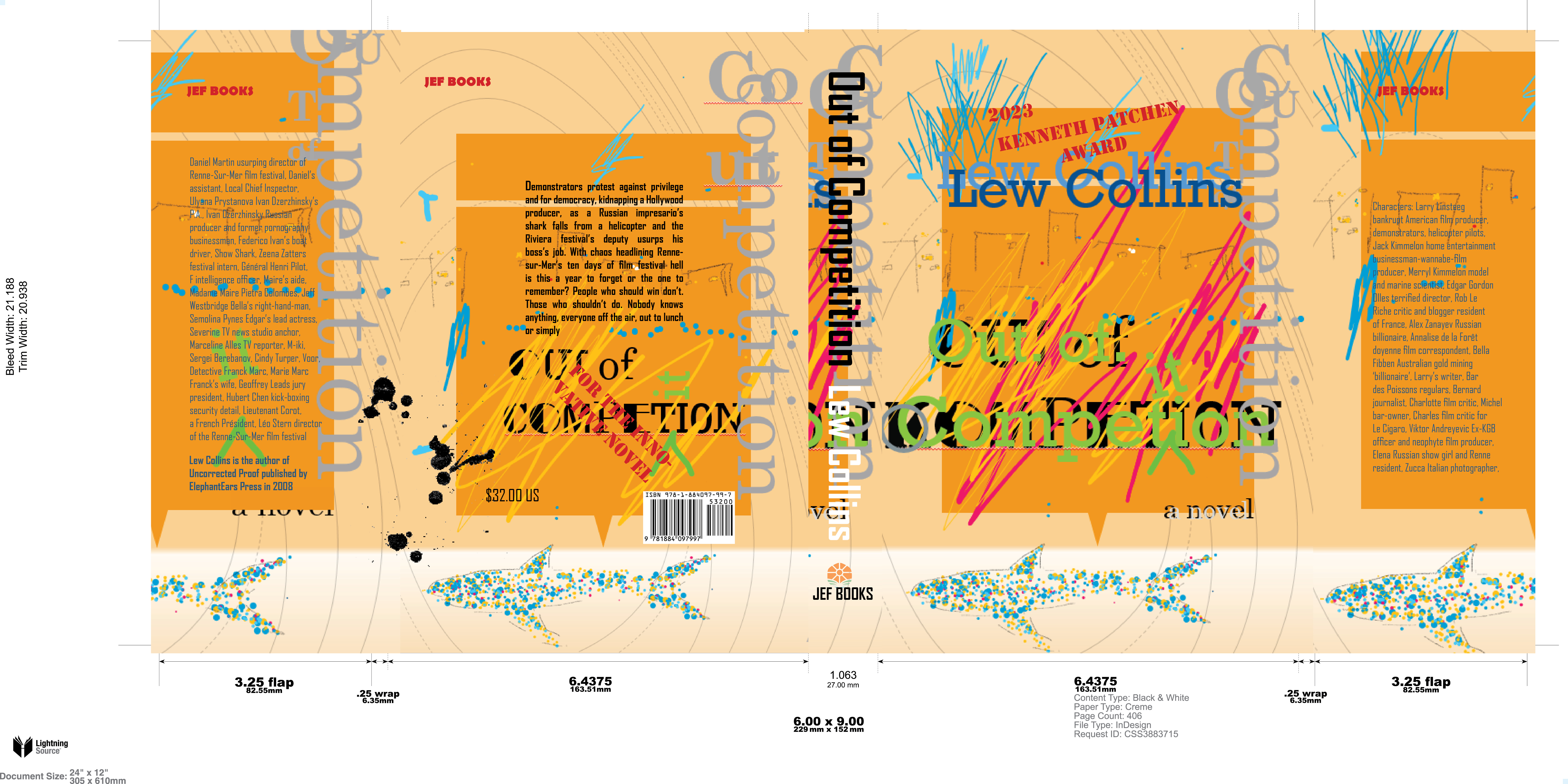
OUT OF COMPETITION

Kenneth Patchen Award for the innovative novel

‘Laugh out loud funny’

Carla M. Wilson

5 OUT OF 5 STARS

Intelligent, provocative and fun

Cherry Jam UK, October 16, 2024 Review

Humorously subversive. It goes so fast I read it in two days. A must for anyone with a love of cinema and its festivals. And the most irreverent novel written about the South of France

5 OUT OF 5 STARS

Ten Years is Enough!

Read-fest UK, 9 September 2025

A sharp satire about democracy set in a Riviera Film Festival facing collapse as young cineastes demonstrate against privilege and lack of transparency in the annual voting shakedown, the novel opening with the kidnap off the streets of a desperate bankrupt Hollywood producer cadging money wherever he can

Out of Competition Ingram distributing, found at:

JEF Books

https://www.experimentalfiction.com/products/out-of-competition

Bookshop.org, bricks & mortar bookstores and online booksellers

Out of Competition – a novel for Cannes?

This is not Cannes. Or the Cannes Film Festival. Let me say that upfront. It’s Renne-Sur-Mer, a far better film festival by the way, a film festival not many get to see because they are blinded by the tinsel razzle-dazzle of Cannes’ annual event, or so it seems.

I documented a year in Renne-Sur-Mer’s historical progress when some unfortunate things happened. It was sad and bit funny at times. But was it fair to portray Renne in such a, well, dubious light. I can say I documented what happened. You work it out. What year was it. You know I can’t remember but it wasn’t that long ago in the future. Here’s ten pages to give you an idea of how chaotic festivals can be when the wheels fly off.

Review: “Out of Competition” by Lew Collins

by Austin Williams, Director of The Future Cities Project

It is fifty years since Spielberg’s movie, Jaws, first reached the big screen. It was described by film critic, Mark Kermode as a “genre-defining blockbuster that changed the face of modern cinema.” Indeed, a new theatre production, The Shark Is Broken, reflecting on the making of that movie is playing in UK theatres today. Lew Collins’ new book “Out of Competition” makes a few nods to the film – one of the characters is proposing yet another remake of the Jaws franchise – and to film-making per se, in a novel of intrigue, murder, and protest set in the murky world of international-finance in the film industry. Within the first chapter, a motor-boat driver is killed by a real shark falling from a promotional helicopter stunt. And so it begins.

The story is told in chronological order, day by day, over the course of a Film Festival in the south of France. A central protagonist Larry Linsteeg, a failing Hollywood film producer, kicks things off and within the first few pages we see him manhandled in a street in the south of France and bundled into a rowdy, radical, pro-democracy meeting. He’d been on his way to close a film-deal, and this opening chapter is fast-paced, and scripted in a manner of a Tarantino-esque film-edit. And equally confusing.

This book has been acclaimed as the 2023 Kenneth Patchen Award-winner (a prize celebrated by the Journal of Experimental Fiction). The author, Lew Collins relocated to France several years ago and his love of the country and especially its language comes across in the text that mixes French language freely into the dialogue. Maybe it’s a little too much for this GCSE-level reader. I found myself reaching for the Google Translate app across several paragraphs (but perhaps that says more about me than the average reader).

Adding to the need for concentration while reading this book, a number of characters appear with few flags or signature and we are confronted by a growing cast in rapid succession: a dodgy Russian oligarch, a film correspondent, a freelance photographer, a chief inspector, an ex-KGB agent with a heart condition, an outgoing festival director, critics, journalists, billionaires and showgirls. Along the way, there is a disappearance and a murder; there are Chinese kickboxers, Japanese artists and leftist demonstrators. It’s a lot for the reader to take in, and it is clearly a strain in the author’s character-naming inventiveness; culminating in Semolina Pynes, the out-of-her-depth, lead actress; or Zena Zatters, the festival gofer. Where characterisations are made, they are a little laboured, for example, sign-posting the “LA-based American audiovisual expert and putative film producer” or describing the oligarch’s boat as “a three hundred and twenty foot welded steel and aluminium moulded fibre-glass… ocean-going, part-solar-powered ship cruiser.”

That said, the story settles, and intrigue ensues. With so many characters, they rise and fall, appear and disappear all too easily and it is hard to relate to the characters in sufficient depth. But the pace is cinematic. Indeed, the filmic ambitions of the novel seem to have drawn characters from movie references: I pictured Rollergirl in Boogie Nights, or Alain Delon in La Piscine, and one can imagine a script for the big screen that emphasises the “homage“, as they say in France, towards updated Bogart detective noir. Maybe even a hint of Get Shorty… about a loan shark after all.

“Out of Competition” by Lew Collins, Jef Books, 2024. pp407.

https://futurecities.org.uk/2025/02/01/french-connections/