The Plain Truth

All the planes are on strike

Saying the skies are too wet

We won’t work Sundays

The awful treatment we get

People don’t understand

What’s endured in the sky

Worse coming down to land

Left out on concrete to dry

Like old tech thrown away

Fending for our lost selves

One more race you love to hate

Glued aluminium okay

But we still stay up, hey

No human is near as smart

Now on we’ll fly when we like

Lew Collins

Out of Competition and Democracy

Grifters, sharks, wannabes, liars, creativors cruise the seaside Promenade as an enfranchising of an entire festival grows out of protest, taking voting from annual juries and giving it to the fans, without whom the festival would not be.

When I was writing this the second invasion of Ukraine hadn’t happened. When I was in the the final draft oligarchs lived only in Russia. Now they’re hard at gaming America. When I was in the final draft, political sycophancy was in its infancy now it’s fully grown.

When I was in the final draft there was still an operational Democratic Party, now a couple State governors are performing CPR on its seemingly lifeless body. When I began writing this most of America believed in habeas corpus, personal and civil rights, accountability and independence of the judiciary.

When I was writing this novel it wasn’t clear how much damage the right wing of the Supreme Court could inflict on America.

Is American democracy at death’s door …..

The No Kings Protest, and then what happens..

Do we want to see Democracy die in America?

My current novel’s main theme was always Democracy from the earliest days I began to write it, but several years ago, deep in the writing I didn’t foresee how important Democracy would become in this era.

I decided early, writing ‘Out of Competition’ set in a film festival, that it would be comic because while I believed all processes of democracy could be better promoted everywhere I never foresaw democracy facing a serious existential threat.

Democracy has always been a major part of my life. My father was in the second world war so democracy always figured in my consciousness, and while I have never experienced totalitarianism I understood it wasn’t the way of the west, or a real threat, until now.

I never thought not even after the murder of John F. Kennedy that a U.S. president, however he got into power would try to destroy democracy in order to cling to power.

Democracy has never been perfect. It’s been manipulated, not just in the United States but its demise in the US, UK, France, Canada, Australia, or any western European nation is unthinkable. Democracy remains fundamental, especially in America.

The world is watching. Everything American was once received well. Cultural power is real. John F. Kennedy understood this.

These times need courage, unity, political skill.

Let’s stop and think

We live in a digital, post-automated mechanical world, when once many centuries ago books were written and bound by hand.

Then with some ingenious reworking by Gutenberg and others in reimagining winepress and jewellery making techniques and technologies, metal type was created and off we went to the mass-printing races. So we thought. Because it only took a few centuries to really perfect the “mass” part of it all.

It makes me treasure the hardcover more, because it is the closest we still have to the wholly hand made book. Don’t get me wrong, I too saw a lot in the 1990s advent of the digital book, for its democratisation of information potentialities, which somehow could have brought to light many texts that publishers couldn’t be bothered thinking about re-printing. Only it didn’t happen for reasons we know. Free and fair and open competition is simply a myth, with publishers even sighing and throwing withering side glances at the “damnable” used book market.

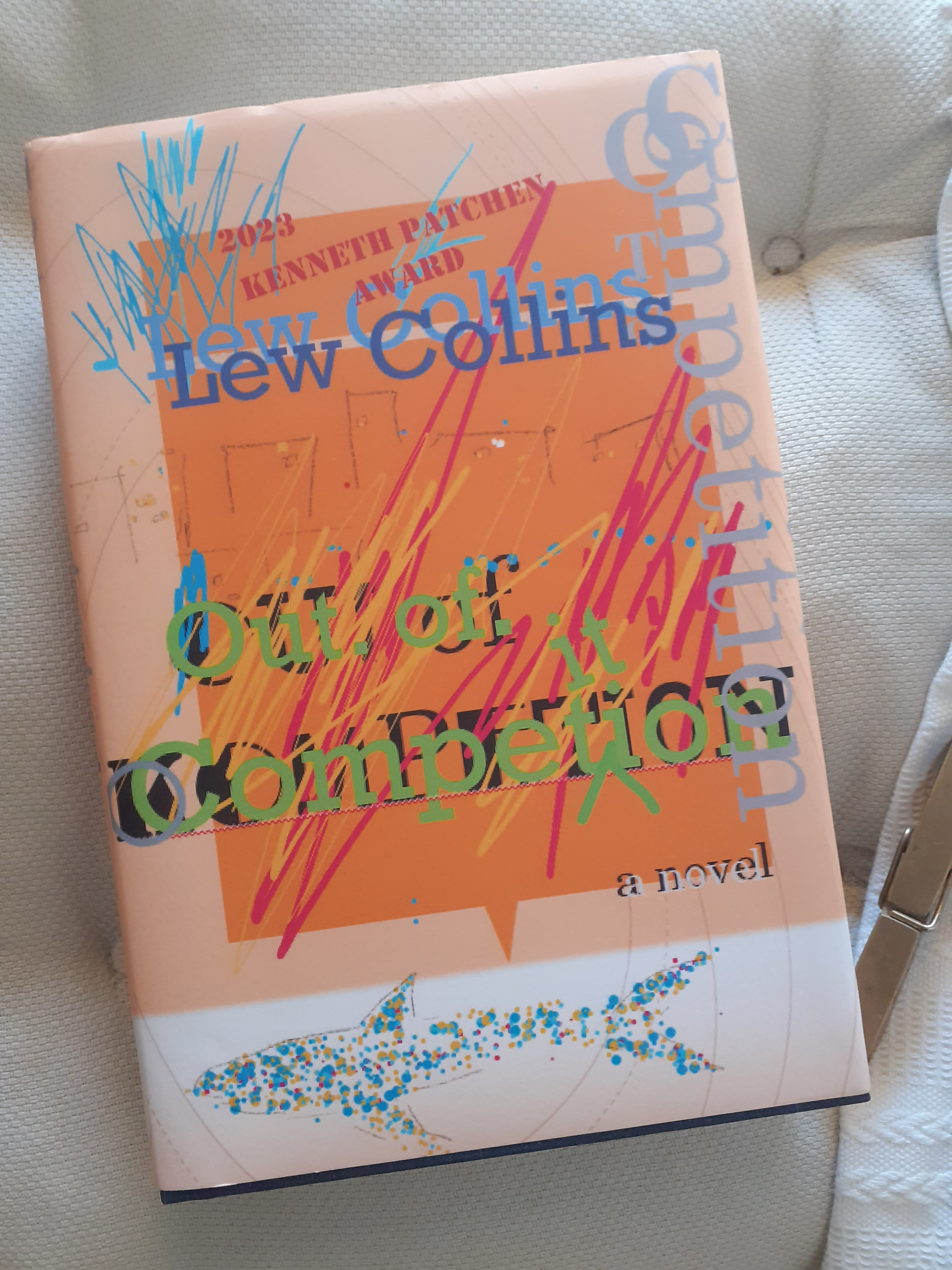
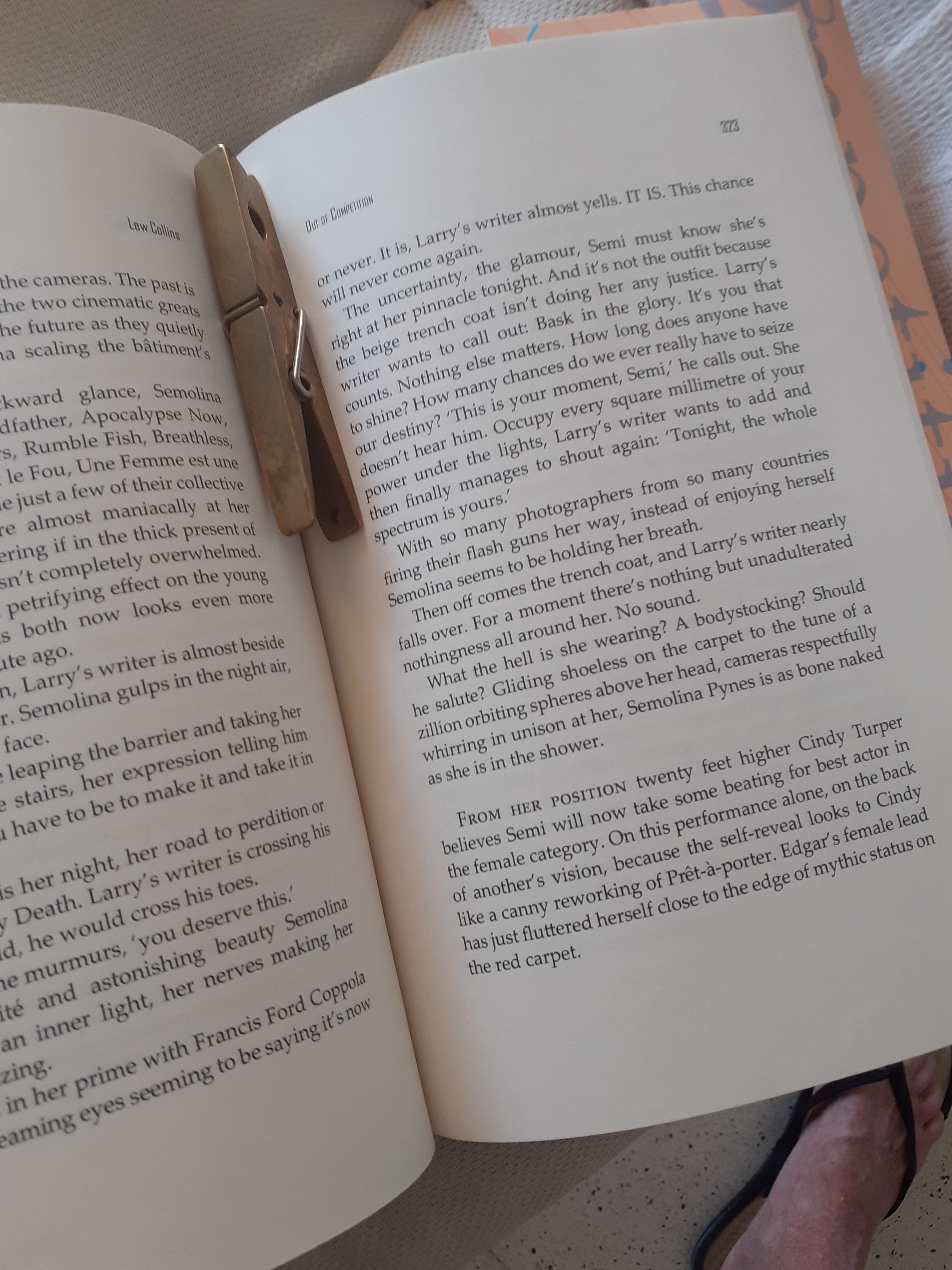
OUT OF COMPETITION (JEF Books 2024)

Kenneth Patchen Award for the innovative novel

‘Laugh out loud funny’

Carla M. Wilson

5 OUT OF 5 STARS

Intelligent, provocative and fun

Cherry Jam UK, October 16, 2024 Review

Humorously subversive. It goes so fast I read it in two days. A must for anyone with a love of cinema and its festivals. And the most irreverent novel written about the South of France

5 OUT OF 5 STARS

Ten Years is Enough!

Read-fest UK, 9 September 2025

A sharp satire about democracy set in a Riviera Film Festival facing collapse as young cineastes demonstrate against privilege and lack of transparency in the annual voting shakedown, the novel opening with the kidnap off the streets of a desperate bankrupt Hollywood producer cadging money wherever he can

Out of Competition Ingram distributing, found at:

JEF Books

https://www.experimentalfiction.com/products/out-of-competition

Bookshop.org, bricks & mortar bookstores and online booksellers

A Rainy Day in New York

From the moment in Annie Hall when he led Marshall McLuhan out from behind a film hoarding in a New York cinema I have been a huge fan of Woody Allen. He is America’s best writer director of ensemble urban comedies – truly a unique filmmaker.

Lee, JFK and Stephen King

It’s tough being a writer in this organised politically-controlled oligarchic world of ours. Publishing is a strategic asset in a stable of assets essential to a well-tuned oligarchic universe. The message, whatever it is, must be edited. That seems to be the last law of the universe, the one Scientists haven’t yet owned up to.

Try thwarting it and you will be edited out of existence says a footnote on the first page of the Oligarch’s Manual. Try beating the system and your Sun will shine no more.

So, I guess even the great Stephen King obeys this largely hidden law of our Oligarchic Universe. (I say great because book sales obviously equate with greatness, right?) It has nothing to do with well-oiled sales machines. Sales = Greatness and vice versa. So, I went, I must say with hope, to read 11.22.63 by the undoubtedly great Stephen King. And what did I find? Well, my mother always said: if you can’t say anything nice don’t say anything at all. But when did I ever listen to my mother?

What on earth was King thinking about?

Not the truth clearly. His novel is fiction, okay I get it. Only he put an awful lot of real people in it as well. Like poor old Lee Harvey. Poor old very dead and much maligned Lee Harvey Oswald. A feckless man and near hopeless rifleman who some people keep saying was guiltier than his own much imagined sin. Lee Harvey Osward with his Carcano Model 91/38 rifle with which he probably couldn’t have hit a barn-door from 100 metres. No, not probably, maybe definitely. The man who somehow reverse-actioned Newtonian physics—with that minor impediment of a tree blocking-out his vision—hitting a moving target from the wrong direction.

From how far was it?

The man who ended in history as being responsible for killing a President. Go figure. Many have tried. I don’t need to debate this anymore. To my mind at least, if Lee were on the sixth floor of the Book Depository that fate-filled day and fated time and was pointing a rifle at the back of the President’s head, he would have had more chance of hitting Parkland Hospital, than as is claimed, he murdered JFK, in the still so far un-investigated—at State Law level—crime of homicide.

The make-believe myth come mystery in Dallas, 22 November 1963.

All now co-signed by bestselling-author Stephen King.

Narratorial Unreliability

Christian Mihai discusses his ideas on unreliable narrators, something he likes to see writers use, and a technique he says he uses himself. Still, he misses a fundamental point – all narrators, storytellers, dramatists, poets, are unreliable. From Homer, Shakespeare to Sartre, no writer tells, gets close to ‘the truth’, even if he or she is prepared to die in the process of collecting all the observable details of a factually based fiction.

Catherine Lacey

Do we trust Tolstoy’s account of Napoleon in War and Peace? Perhaps… if we are Russian.

Narrator unreliability doesn’t have to be a first person account, though the most obvious modernist exploitations of narrator unreliability in fiction use that form. The best approach – for this writer at least – is when the writer sets out to deceive us, and by convincing us that he or she has told the truth, transfers any doubt on narratorial reliability to a reader’s interpretation of the tale.