Plot…is that all there is to fiction?

Laura Miller of Salon is one of a long line of ‘I know best-ers’ to throw the tired old crumbly stones of  ‘writing commandments’ from the journalistic mountaintop http://www.salon.com/books/laura_miller/2010/02/23/readers_advice_to_writers/index.html(was-there-not-anymore) :

  1. Make your main character want something.
  2. Make your main character do something.
  3. The components of a novel that readers care about most are, in order: story, characters, theme, atmosphere/setting.
  4. Remember that nobody agrees on what a beautiful prose style is and most readers either can’t recognize “good writing” or don’t value it that much.
  5. A sense of humor couldn’t hurt.

Anyone who champions rules of commercial fiction risks sinking creativity to the lowest common denominator in the reader’s mind. It is so easy to force feed unknowing audiences junk culture, just as easy as it has been to promote junk food. And where has junk food got us? If Laura or anyone attacks quality or ‘difference’ be it in art, commercial fiction, food or politics, in the end, logically, it leads to totalitarianism. Commercial control of a cultural market, or political control of a society have similar roots.

We are not animals tethered to a plot line only – sophisticated readers want more than plot. If anyone reads War and Peace (a great read by the way, easy to read, entertaining and enjoyable) it is a long time before any one character assumes ‘the what’s going to happen to me next driver’ aspect to his or her role, but it is there – but it is always there as part of ‘the life’ in the novel – what will happen today? It is part of all of us – but there is much more to enjoy in Tolstoy’s novel, as there is in reading Year of the Death of Ricardo Reis, The Outsider, As I lay Dying, and A Hundred Years of Solitude – all examples of novels and narratives that are far more mysterious and compelling than commercial fiction that obeys these silly rules Laura speaks of. In The Great Gatsby, what do we ever discover really of Gatsby? – not a great deal, more than half Fitzgerald’s point. Nick, we get to know, the character we engage with, the thinking centre of the novel. Hamlet was introspective and procrastinating and one of the greatest characters of all time. Just because lowest-common-denominator is now the major dollar driving factor in contemporary reading culture doesn’t make it good or good to read. The only comment I agree with is the last – laugh while you write and hope like hell the reader laughs with you!

“Naturally, writers of genius have broken these “rules” as well as every other rule ever conceived. But, let’s face it, geniuses don’t need lists like this and couldn’t follow them even if they tried. Most writers are not geniuses, and most readers would be exhausted by a literary diet that consisted only of the works of geniuses.”

This is Laura’s ‘a genius can do it, but the rest can’t argument’ which in effect shuts down experiment, closes the door on dissent. Who knows what genius is? It was 200 years before the Romantics woke up and declared Shakespeare a genius. All we can really hope for is that creativity in any novel is whatever form it takes when exciting readers. If a writer takes readers somewhere we haven’t been, surprises us in some way then it is an achievement worth applause. The ‘Only a genius can break the rules’ argument is another argument for more gatekeeping. This ‘we know the rules’ is nonsense. And even if someone like Laura could for a moment make a good fist of why she subscribes to her only a genius-can-break-rules-theory, very few of the ‘genius writers’ she’ll choose will surprise even her all of the time. No book or writer is untouchable. Everybody can be criticized, even Shakespeare. Logically, if anyone follows these, or any rules, they will become slaves of a market mechanism. Rules for fiction or any other art form only end up filling the pockets of the chosen and promoted writers. Rules lead straight to homogenization (though that doesn’t mean you can’t have a little fun with rules, while you’re doing other more interesting things) …go-go genius go.


Pacific Rim Review of Books’ review of ‘Uncorrected Proof’

PUBLISH OR DIE! by Paul Duran

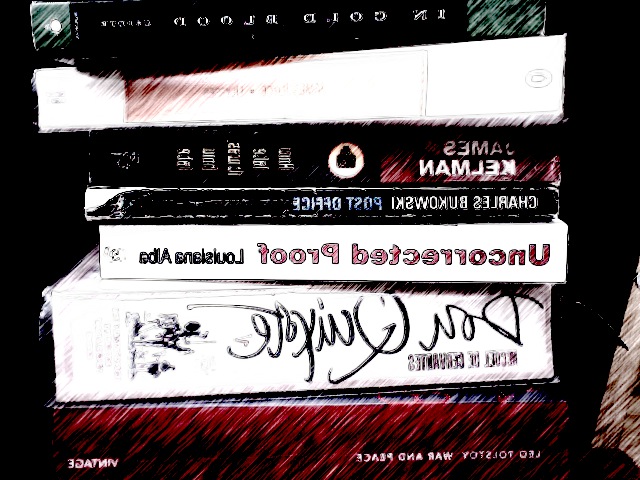
Review of Uncorrected Proof by Louisiana Alba – ElephantEars Press

Paul Duran – L.A. director and writer

from Pacific Rim Review of Books Fall/Winter 2009 Issue 12 – pg. 33


Who is Louisiana Alba and what does she (or he) have against the publishing industry? It’s a rhetorical question since most authors inevitably have some gripe against the media giants they are forced to rely upon to shepherd their creative works to the masses. Yet usually, besides the odd drunken cocktail party diatribe or expletive-laden rant to one’s spouse, authors won’t, or can’t afford to, bite the hand that feeds them. Alba on the other hand has decided to go straight for their throats, going public with the writer’s eternal screech – the bastards have    (add your own word here – ruined, stolen, fucked up, etc.) my book! – then framed it within a literary conceit so audacious and capricious, that to stumble just a little bit is to fall off the mountain completely.

It’s a high wire act that literally co-opts the style of dozens of literary untouchables and pop culture icons from James Joyce to Jimi Hendrix, Anthony Burgess to Andy Warhol, Ernest Hemingway to Quentin Tarantino (there are over a hundred authors and artists listed in the book’s acknowledgements starting with ABBA!). Alba (an obvious nom de plume) uses each successive voice in her vast arsenal to tell the story of Archie Lee, the plagiarized author who schemes to get his novel back from the people who stole it – the celebrity novelist Martyrn Varginas, his greedy publisher Menny Lowes, and his man-eater of an editor, Ellen Spartan.

Using The Iliad as a starting reference point (in a deliberate cracked mirror image to Joyce’s use of The Odyssey in Ulysses), the novel playfully winks at Homer not so much for his epic poem’s style as for its archetypal tale of love, abduction and revenge. The characters all are sly doppelgangers for their Greek counterparts; Archie Lee for Achilles; Ellen Spartan for Helen; Menny Lowes for Menelaus and so on. But the book does not rely solely on post-modern mimicry or clever homage to keep our interest. It more than holds it’s own as a thoroughly enjoyable pulp story about stolen manuscripts and deferred vengeance in the volatile, cutthroat world of publishing. Making publishing a life and death enterprise involving kidnapping, murder and the CIA is a nice conceit that no doubt will give even the crustiest of publishing execs a knowing chuckle.

The novel starts with Archie out to expose his literary theft at the Crocker Prize banquet (read Booker Prize). He gets cold feet when he comes face to face with his nemesis Varginas and Varginas’ attractive editor Ellen. She unexpectedly offers Archie a position at her new imprint when he stammers out that he’s “expert with espionage thrillers.” From there the story follows Archie’s desperate scheme to wreak revenge from inside the publishing mecca using his newfound influence to try to get his original novel into print under the name of an opportunistic young hustler he has hired for the part. Nothing goes according to plan as the novel ricochets from London to Barcelona to the South of France to New York and back; from pulp crime to spy thriller, memoir to meta-fiction, screenplay to redacted text.

It may sound like a daunting task for the narrative to constantly shape-shift from one disparate source to another but the effect is breathtakingly kaleidoscopic and in most cases wholly appropriate (even the few typos in the book seem correct given the title). In truth it would probably take a tenured literature professor with a vast music and DVD collection to decode all the stylistic shifts in Uncorrected Proof but that’s not really the point. Given all the literary byplay and conceptual ambition, the story is still amazingly accessible, so when you are able to pick up on a particular author or style, it just adds to its kicky pleasure.

In the end Uncorrected Proof is also a cautionary tale about ego and ambition run amok in a world where ego and ambition are the only character traits that seem to really matter. With no clear winners or losers it could almost be read as a twisted metaphor for our own troubled times, with the publishing industry standing in for Wall Street and the banks, where the “best and brightest” have had their way for too long and have grown fat on the bones of those crushed under their Gucci loafers and stiletto heels. Perhaps I’m reading too much into Alba’s remarkably varied prose, but the seeds of a revolution are there, if not on the economic front, then maybe just in the publishing house.

Paul Duran’s films, Flesh SuitcaseThe Dogwalker.

Another review by LiteraryMinded please go to:

http://blogs.crikey.com.au/literaryminded/2008/11/07/uncorrected-proof-louisiana-alba/

elephant-ears-8-2
 

Let’s Bet on Independents

Borders is dead, long live the independents.

When Borders came into the UK and bought up Books etc, what happened? A superb small bookshop chain that knew what it was doing slipped out of sight. We know what BIG can do. It goes bust with a BANG in bad times, well, a dull thud in this case.

Do we get the message? BIG doesn’t work in tough times. So why not support the people who are there for us with books year in and year out.

In my area there’s ONLY one – Stoke Newington Bookshop – owned and run by Jo for the last twenty-two years. She’s seen whole families of readers grow up, took over the floor space when Barclays moved out..remember that? A bit before my time. Jo has weathered rent rises, publisher and writer collapses, buyers and banks coming and going.

It’s a superb shop, one of the best book table layouts I’ve ever seen. If you are a  reader who likes to book-browse without pressure this is the shop for you.

Stoke Newington Bookshop 159 Stoke Newington High Street, London, N16 0NY (near the t-junction with Stoke Newington Church Street)


Progress of the Novel

Image – ElephantEars Press

The novel has seen so many developments on so fronts through its long history in many languages and periods of history. It began with Cervantes and still is going strong. ElephantEars Press through its Facebook group Progress of the Novel, wants to learn of innovative novels, ‘gems’ published in recent years.

(posting for ElephantEars Press)

http://www.facebook.com/group.php?gid=199000248124&ref=mf

It’s enough to be in Paris

BILD2186


I went to Paris for my birthday (had to say it at least once). Found a wonderful hotel, with the sort of market just two minutes away you can only find in France. Combination of food on sale and items and atmosphere. Checked the book in Shakespeare and Co. Have a look, too – Uncorrected Proof, under A for Alba.


BILD2132

BILD2070
BILD2080

Walked the streets. Passed through, open-mouthed, the commercial alleys of the left bank. Should manic tourism do this to such a brilliant part of the city? Up and away through Montparnasse, by the Pantheon and back down by Joyce’s home (one of 13 while he was in Paris).* I  just found the address without any idea where it was, wasn’t even thinking of him. Now I’m asking myself what are the chances of chancing on it in a city the size of Paris.


BILD2123

Not one for tourist plaques or gravestones but this is worth lingering by.


BILD2177

Really didn’t do all that much in two days –  didn’t lunch or dinner at expensive restaurants, didn’t even tea or coffee in les deux magots. Just absorbed the sounds and sights from train to train. It’s enough to be in Paris.


BILD2159BILD2113
BILD2116

* As the New York Times tells us, it was Joyce’s “prettiest place…Valery Larbaud’s apartment in a kind of mews at 73 Rue Cardinal Lemoine, on the Contrescarpe behind the Pantheon and with curving view of Paris.”

Happy Bloomsday

Though they didn’t see eye to eye in everything a certain analogy there somehow was as if both their minds were travelling, so to speak, in one train of thought. p536 ‘ULYSSES’ – THE CORRECTED TEXT

As summer reaches for its solstice, as the stones of Big Ben time tremble from Stonehenge right around the world, as the polititudinous rage bleeds in ancient places and I sharpen these scribal tools to palimpsest my way through another 16th, I salute old JJ, for his ‘galaxy of new devices and stances and verbal antics, extravagant, derisive, savage, rollicking, tender and lyrical… ironic dominion.’ (thankees to Richard Ellman)

Let’s all salute  oldy-poldy JJ his voices talking at us still, twirling in time all this live long day, as we take a moment to let ourselves be literarily astounded  all o’er agin by  his thesis for true intelligence….

We are all equal every wingy, tready, swimmy, barking one of us

_.._IICManager_Upload_IMG_NewYork_joyce 2

Open Letter To Google on Plagiarism

Google, Inc.
Google Legal Support,

AdSense DMCA Complaints
1600 Amphitheatre Parkway
Mountain View, CA 94043

U.S.A.

19 May, 2009

Dear Sirs,

I am writing to point out Google’s association – inadvertent association, I accept – with the blatant theft of my copyrighted material by a site It’ s Entertainment, blazoned with Google Ads. The offending site is set up using DoshDosh.com powered WordPress software and can be found at: http://entertainment.uwant2know.info/cannes-film-festival-2009-the-big-time/

It’s Entertainment is engaging in unauthorised holus bolus copy-theft of my original material from a post I wrote, based on a research trip I made to Cannes last week for my new novel. My original post can be found on my blog at:

https://swimanog.wordpress.com I put the post up on 18th May, 2009. It was barely up one hour before It’s Entertainment began using it illegally for commercial purposes with Google Ads.

I received no request by It’s Entertainment for its use and there was no attempt to properly acknowledge the original. There is no way to contact the site owners to register my disquiet or complaint. From my research, this site is a serial offender of this kind of copy-theft.

I am a novelist and I put up my blog posts up for public awareness of my writing and for the public’s and my own enjoyment. It’s Entertainment is stealing copyrighted material placed in good faith on the World Wide Web. Google, inadvertently and unfortunately, is aiding and abetting It’s Entertainment by giving it sustenance to survive, so the offending site can carry out copy-theft.

Please help stop this abuse by withdrawing the site’s ability to use Google Ads. The site’s unauthorised use of my writing is unlawful, unfair and wrong. Google should prevent sites like this one from acting like this. Your company will be doing a great service to everyone and will win wide respect if it does. At the very least sites like this should be forced to negotiate legal use of copy. I am not against the use of Google Ads on any site per se but have not investigated it. I am not against commercial activity, only against illegal copyright activity carried out for commercial exploitation.

The use of my copyrighted materials as described above is not authorized by me, or the law. I swear, under penalty of perjury, that the information in the notification is accurate and that I am the copyright owner of an exclusive right that is allegedly infringed. My thanks for your consideration of this matter.

Yours faithfully,

Louisiana Alba

Cannes Film Festival

– The Big Time

You’re in the south of France.

BILD1328

BILD1322

You arrive on the TGV, in a bit of a blur…

BILD1282

Right, where’s your place then. Christ, you hope you haven’t been conned. You walk out of the station, get lost in two minutes. How do you get lost in Cannes when you’ve been there ten times. You just do. But up the hill you go, eventually, get there, find the place…believe you me, well away from the hoy palloy.

BILD1140

Not bad, you think, for something off the Internet, okay, away from the action, on the other side of the train line, but it has a beautiful garden…

BILD1187

A bit Graham Greenish, even. But you are here to work, not to sit in a garden deck chair, sip pink gins, complain about being an Anglophone abroad all day long. You are here to take photos. You get started right away..

BILD1213

Get the writing tools set up…BILD1177

Right then, down to the Croisette..

BILD1266

To do what? Gawk at the stars…

BILD1218

Where are the stars anyway? Up on bill boards or hiding in hotels. Maybe the key is to be a star yourself…get yourself somehow onto one of these bill boards even…but how do you do that?

BILD1229

You could simulate the process..

BILD1232

Or take a leaf out of the books of others, mix in with the media..

BILD1244

Wait, maybe you don’t look the part. Do  you need a special pair of shoes, a hat even?

BILD1280

At these prices, forget it. But you know how to climb all over the competition, get head and shoulders above the crowd.

BILD1251

But what are you looking for anyway, or at, what do you hope to see?

BILD1305

Is cinema just another empty business?

BILD1246

Or is that all just a bit too serious.

What to do? You could dress up, give someone a laugh, at least..

BILD1307

BILD1309

Or get drunk…

BILD1127

…or find yourself an empty chair.

BILD1302

Stare at the scenery..

BILD1310

BILD1311

…yr mind all out to sea.

BILD1312

BILD1297

This site’s content is copyright. All Rights reserved.

Credit where, all hail to..

It is, I assure you, an infuriating mess, a refuge, a joy to behold, an acrimonious cesspool of computerisable angst, an endless checklist of outso(u)rcerized disputes – a hole in the wall for all the world’s minds to filter down onto damaged DVDs. They will in time. And this you will find will be their final resting place.

The staff are miraculous, critically underpaid, limitlessly incompetent, irritatingly profound, delightfully empty, lazified beyond imagining, utterly perfect in their rhombus like cartoon feature creatures silicon graphic simulatoring carnival spirit. They sit there one at a time in that hell’s kitchen like Camusian sentences in utter knowing decrepitude.

If I could ever find the title I crave, the one I have up here, I will throw a week long party for all of you (send me yr contact). As a photocopier – though – to be honest – let’s be fair – my local is the soul of efficiency. As a printer of documents it is besmirchless –

….any fault the computer hard-drives at you is not down to the poor beleaguered impoverished centre.

It is a meeting, as it were or was – point by point – planned, for the perfect silence of minds, brought to life ONLY by murmuring mobile phonies and at least one hundred SE-a-MLESS dialects.

Not a letter I know is transferrable in order to patronise misapplication by default (if you know how to approach it). So…All hail to my local

….– library.

Intentional fallacy

It was called the intentional fallacy when I was at university  – meaning for me  that the author is not really a good judge of her or his work, doesn’t really understand what has been written.

Roland Barthes spoke of something similar in the The Death of the Author. I would have liked to have talked to Barthes back at university about it, instead of much later in my head when postmodernism seeped into my consciousness. It would have provided a shorter route to where I believe I am than the road I took. But at least I heard of intentional fallacy and it had an effect on my understanding of how literary works are constructed (or not). And then I heard of Barthes and many others later, and my understanding deepened.

One intentional fallacy I would like to point at in Uncorrected Proof (or maybe it’s not really an intentional fallacy, more a mistake) –  I based the novel (a little tongue in cheek, I admit) on the prelude/the history of Helen and Greece prior to the context of the Iliad and then fast-forwarded to the finale of Homer’s poem itself. For me any strict following of Homer’s martial poem would have been a weight I didn’t need. I felt in my heart that I had the greatest on my side in this, and that if Shakespeare were  Joyce he might have decided on a less strict following of the Odyssey for Ulysses, and given more emphasis in Bloom‘s narrative to ‘story’. For me, Shakespeare knew how to use story as a platform for other literary ventures. Joyce it seemed didn’t ‘do’ story or didn’t want to understand it, seeing story as a unnatural structure forced upon him by commercial literary progress, at least so it seems in Ulysses and Finnegans Wake. But there is story in Ulysses, just it isn’t in any way commercial. Did Joyce intend to deconstruct story or did he simply not do it well?

The intentional fallacy (is it one or not?) I must own up to in Uncorrected Proof is this: in my creation of one particular character I intended for readers to read the words as I pronounced them in my head. And one word with a possible reader-mispronunciation attached to it only occurred to me recently, a mispronunciation that might have some politically correct readers catching their collective breath.

For reasons that shall remain in code, I named my genre plagiarist novelist in the story- Martyrn Varginas.

I lived in Italy and speak Italian and understand the Greek and latin bases to western European languages, so for me, Varginas, without question, is pronounced as the Greeks might, with the main accented syllable being the first Vár (as in are)-gin (as the drink)as (mass)

If it were in Italian the accent would be on gin…definitely NOT as English speakers might read it, with the emphasis on a middle sylalble – gyne – leading the surname to more than hint at the female sexual organ in plural.

Now it is true I realised the implications of making Martyrn’s surname and ‘vaginas’ so close but as I based it on a real name, itself very close to the most actively used pejorative term for the female sexual organ, I deemed it just and fair use. Suddenly (I kid you not) I realised of course that, just as swimmers at my local pool mispronounce Lido lie-dough, instead of lee-dough as it is in the original italian, they would just as readily mispronounce Varginas.

So, for the record: It is Vár (as in are)-gin (as the drink)as (mass)..okay?

Phew. Now that this has been clarified I will move onto the main characters in Uncorrected Proof that are based on the Iliad:

Archie Lees – Archilles

Ellen Spartan – Helen of Sparta

Anthony Gamenman or A.Gamenman(n) – Agamemnon

Menny Lowes – Menelaus

Cal Kline (or Cal Chase or Patrick Locus) – a fusion of Calchas/Patroclus

Dolon – Dolon (perhaps western literature’s first spy)

The first part of the story’s premise: Archie Lees gatecrashes the Crocker Book awards in a hairbrained scheme to get his novel back from the bestselling genre novelist..Martyrn Várginas..the ‘gin sodden half-assed’ hack who plagiarised Archie’s book …

Anymore from me on this subject could inspire some virulent shouts of intentional fallacy.….or worse…