Grifters, sharks, wannabes, liars, creativors cruise the seaside Promenade as an enfranchising of an entire festival grows out of protest, taking voting from annual juries and giving it to the fans, without whom the festival would not be.
When I was writing this the second invasion of Ukraine hadn’t happened. When I was in the the final draft oligarchs lived only in Russia. Now they’re hard at gaming America. When I was in the final draft, political sycophancy was in its infancy now it’s fully grown.
When I was in the final draft there was still an operational Democratic Party, now a couple State governors are performing CPR on its seemingly lifeless body. When I began writing this most of America believed in habeas corpus, personal and civil rights, accountability and independence of the judiciary.
When I was writing this novel it wasn’t clear how much damage the right wing of the Supreme Court could inflict on America.
My current novel’s main theme was always Democracy from the earliest days I began to write it, but several years ago, deep in the writing I didn’t foresee how important Democracy would become in this era.
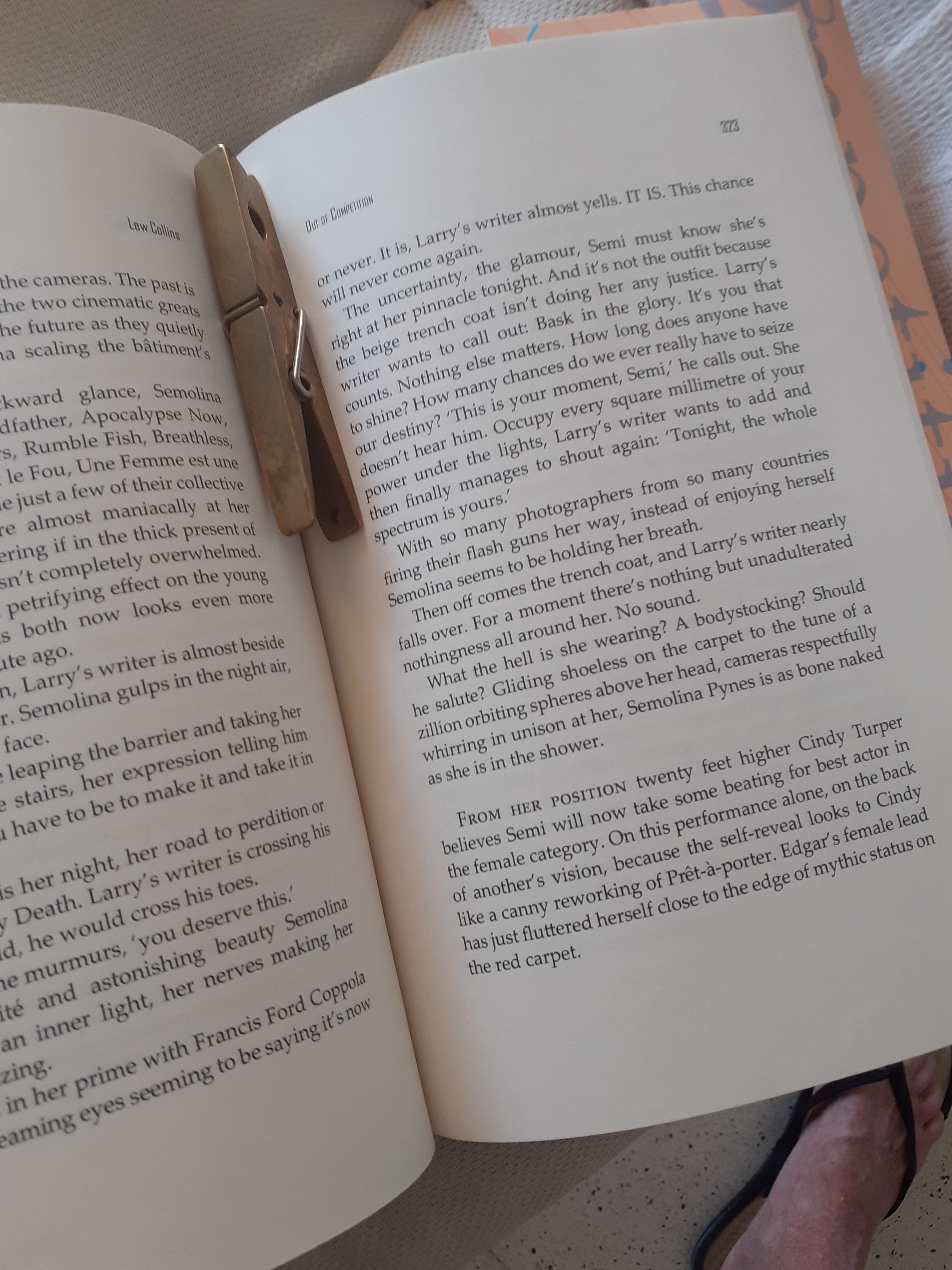
I decided early, writing ‘Out of Competition’ set in a film festival, that it would be comic because while I believed all processes of democracy could be better promoted everywhere I never foresaw democracy facing a serious existential threat.
Democracy has always been a major part of my life. My father was in the second world war so democracy always figured in my consciousness, and while I have never experienced totalitarianism I understood it wasn’t the way of the west, or a real threat, until now.
I never thought not even after the murder of John F. Kennedy that a U.S. president, however he got into power would try to destroy democracy in order to cling to power.
Democracy has never been perfect. It’s been manipulated, not just in the United States but its demise in the US, UK, France, Canada, Australia, or any western European nation is unthinkable. Democracy remains fundamental, especially in America.
The world is watching. Everything American was once received well. Cultural power is real. John F. Kennedy understood this.
We live in a digital, post-automated mechanical world, when once many centuries ago books were written and bound by hand.
Then with some ingenious reworking by Gutenberg and others in reimagining winepress and jewellery making techniques and technologies, metal type was created and off we went to the mass-printing races. So we thought. Because it only took a few centuries to really perfect the “mass” part of it all.
It makes me treasure the hardcover more, because it is the closest we still have to the wholly hand made book. Don’t get me wrong, I too saw a lot in the 1990s advent of the digital book, for its democratisation of information potentialities, which somehow could have brought to light many texts that publishers couldn’t be bothered thinking about re-printing. Only it didn’t happen for reasons we know. Free and fair and open competition is simply a myth, with publishers even sighing and throwing withering side glances at the “damnable” used book market.
I am a writer, novelist, living and writing on the south coast of France, where I swim and continue renovating my apartment.
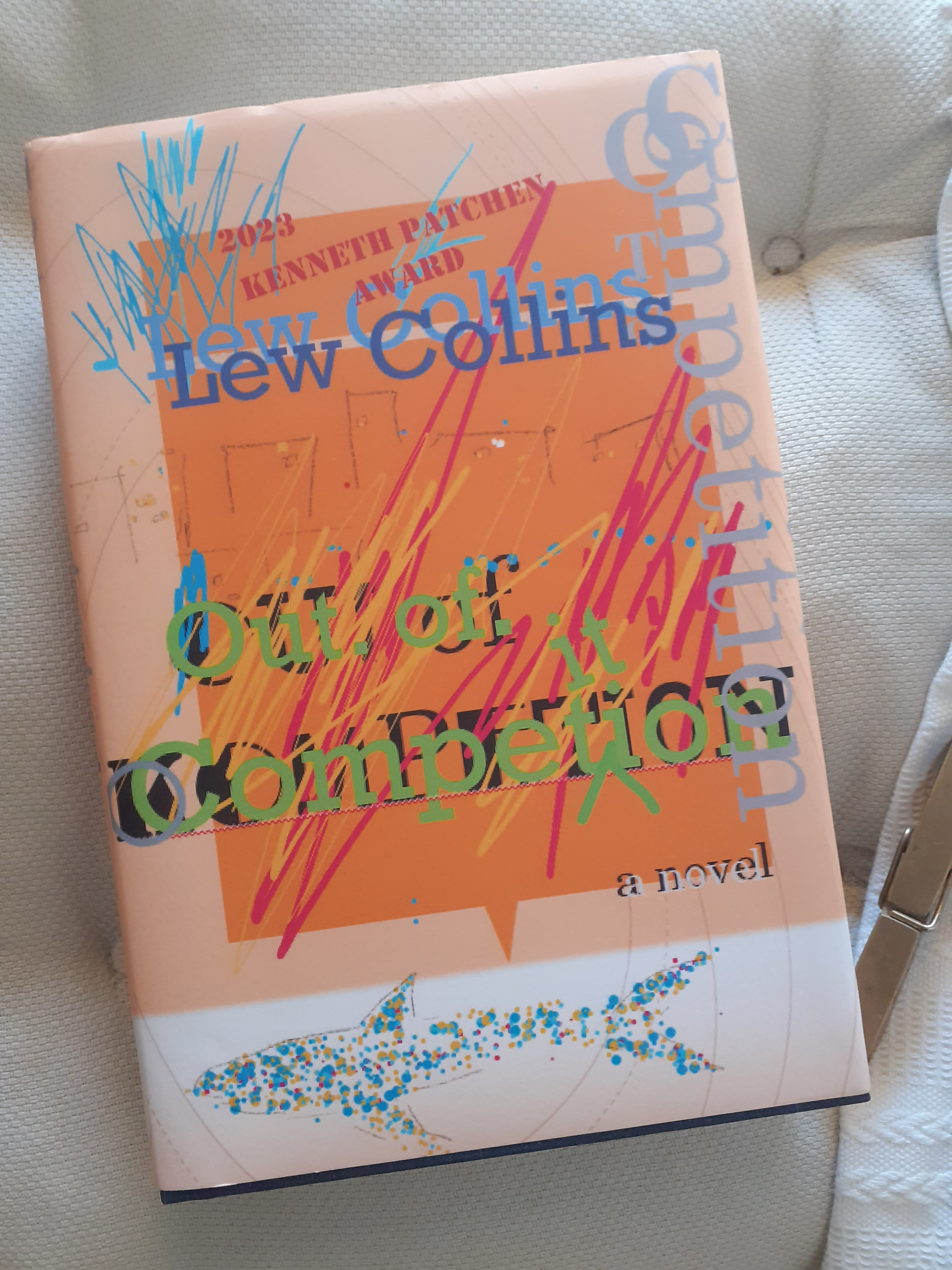
I am very close to finishing a novel set in 1963. My recently published novel Out of Competition, published by JEF Books, Illinois, October 1, 2024 won the Kenneth Patchen Award for the Innovative Novel.
“Let us fight to free the world to do away with greed, with hate and intolerance. Let us fight for a world of reason, a world where science and progress will lead to all people’s happiness.”
“The hate of men will pass, and dictators die, and the power they took from the people will return to the people… liberty will never perish.”
These films are not the best perhaps, or even the best 63 films I have seen, though they would be very close to that.
I simply laid them down without prior thought of ordering or listing them in any kind or categorisation of this or that.
The only change was to add Gosford Park by Robert Altman, and to do that I dropped Mira Nair’s Salaam Bombay! which should not be left out, but I kept Monsoon Wedding which I adored when I first saw it and still do.
So the filmmakers and films are all great and in no way am I listing them in order of best – first to worst. There are no second-best or best here. They are simply all magnificent for all their own reasons and appeared as I remembered them and wrote them down.
Tell me what you think – offer suggestions – i.e. if you wish to.
Robert Bilott’s self-documenting book, Exposure, on Du Pont’s chemical pollution in Parkersburg, West Virginia, is a sobering study of the immorality of corporate America in recent times, a searing book that shows how greed drives so much economic activity in America.
Robert Bilott’s story was first revealed to me when I recently saw the film Dark Waters – a Todd Hayes, directed, and Mark Ruffalo, produced and acted in film, well worthy of several nominations in this year Hollywood awards round. It received none. Reading below, you will soon get the picture why.
Robert Bilott tells us a story that begins with his unusual jumping the fence from his law firm’s usual corporate defence work to take on a plaintiff’s case, a West Virginia farmer, Earl Tennant, who showed up suddenly at his office with a mountain of supporting evidence.
Looking through it all, Bilott discovers how Du Pont had been for years dumping poisonous waste from its Washington Works plant at Parkersburg, West Virginia into landfills which leached into rivers, streams, ponds, killing cattle and compromising the health of inhabitants in a wide area.
This story of corporate carelessness, greed and willingness to do harm, shows the casual, arrogant and ease with which a powerful corporation can engage in immoral practices, seeing it as business as usual.
Initially rebuffed by Du Pont, Bilott convinced the courts to order the company to agree to settle, following an independent scientific investigation into the devastating harm created by a chemical PFOA, used for many products, famously in Teflon, a huge worldwide profit spinner for Du Pont.
Du Pont ruined natural water and piped-water supplies meaning that many were already suffering, some dying, from directly associated diseases and conditions. But it takes years for results from an exhaustive scientific study of the blood samples of nearly 70,000 people in the immediate and surrounding areas to establish clear probable cause links to several major life threatening and life-altering diseases and conditions.
A jury finally finds for a class civil action against the company – who put up a fierce and often devious public relations & legal defence. The plaintiffs were awarded a 670 million dollar settlement against a corporate giant. Du Pont appealed and appealed then in the face of the unshifting evidence folded and accepted the decision.
This ‘environmental crime’ was aided and abetted by the EPA who worked in tandem with Du Pont to obfuscate key facts of a chemical dumping program from the public, Du Pont carrying on its harmful activities for years in plain sight, abusing the basic trust its economic stranglehold allowed them in the small trusting community. Being the town’s main employer Du Pont had the town cold, knowing all along PFOA was an extremely dangerous substance for all life forms.
In summary, this is a necessary read for people who want clean land, air and water, people who want a reasonable chance of living their lives without corporations callously poisoning them – in this case providing them with cancers. This book is for anyone who believes that accountability is sorely needed. Sorely needed too are lawyers who hold to decent norms, who work honourably in a democratically governed society of the 21st century.
Without Earl Tennant bringing this to Robert Bilott’s attention and Bilott deciding to take the career risk of bringing a civil action on behalf of Earl and many others, with him and victims together facing down so many stress-filled years, we may never have even heard about Du Pont’s malfeasance.
Note: In a run up to the class-actiontrial, Du Pont spun off its Washington Works plant into a new company, Chemours, a spin-off technique many companies use to limit financial damage, placing the offending product range under another firm, a firm that can easily be tipped into bankruptcy thus preventing a payout. After years of seeing how Du Pont operated Robert Bilott was ready for the tactic.
It’s tough being a writer in this organised politically-controlled oligarchic world of ours. Publishing is a strategic asset in a stable of assets essential to a well-tuned oligarchic universe. The message, whatever it is, must be edited. That seems to be the last law of the universe, the one Scientists haven’t yet owned up to.
Try thwarting it and you will be edited out of existence says a footnote on the first page of the Oligarch’s Manual. Try beating the system and your Sun will shine no more.
So, I guess even the great Stephen King obeys this largely hidden law of our Oligarchic Universe. (I say great because book sales obviously equate with greatness, right?) It has nothing to do with well-oiled sales machines. Sales = Greatness and vice versa. So, I went, I must say with hope, to read 11.22.63 by the undoubtedly great Stephen King. And what did I find? Well, my mother always said: if you can’t say anything nice don’t say anything at all. But when did I ever listen to my mother?
What on earth was King thinking about?
Not the truth clearly. His novel is fiction, okay I get it. Only he put an awful lot of real people in it as well. Like poor old Lee Harvey. Poor old very dead and much maligned Lee Harvey Oswald. A feckless man and near hopeless rifleman who some people keep saying was guiltier than his own much imagined sin. Lee Harvey Osward with his Carcano Model 91/38 rifle with which he probably couldn’t have hit a barn-door from 100 metres. No, not probably, maybe definitely. The man who somehow reverse-actioned Newtonian physics—with that minor impediment of a tree blocking-out his vision—hitting a moving target from the wrong direction.
From how far was it?
The man who ended in history as being responsible for killing a President. Go figure. Many have tried. I don’t need to debate this anymore. To my mind at least, if Lee were on the sixth floor of the Book Depository that fate-filled day and fated time and was pointing a rifle at the back of the President’s head, he would have had more chance of hitting Parkland Hospital, than as is claimed, he murdered JFK, in the still so far un-investigated—at State Law level—crime of homicide.
The make-believe myth come mystery in Dallas, 22 November 1963.
All now co-signed by bestselling-author Stephen King.
Christian Mihai discusses his ideas on unreliable narrators, something he likes to see writers use, and a technique he says he uses himself. Still, he misses a fundamental point – all narrators, storytellers, dramatists, poets, are unreliable. From Homer, Shakespeare to Sartre, no writer tells, gets close to ‘the truth’, even if he or she is prepared to die in the process of collecting all the observable details of a factually based fiction.
Do we trust Tolstoy’s account of Napoleon in War and Peace? Perhaps… if we are Russian.
Narrator unreliability doesn’t have to be a first person account, though the most obvious modernist exploitations of narrator unreliability in fiction use that form. The best approach – for this writer at least – is when the writer sets out to deceive us, and by convincing us that he or she has told the truth, transfers any doubt on narratorial reliability to a reader’s interpretation of the tale.